
For most automakers, selling more cars is one of the main ways to grow.
Ferrari follows a different logic.
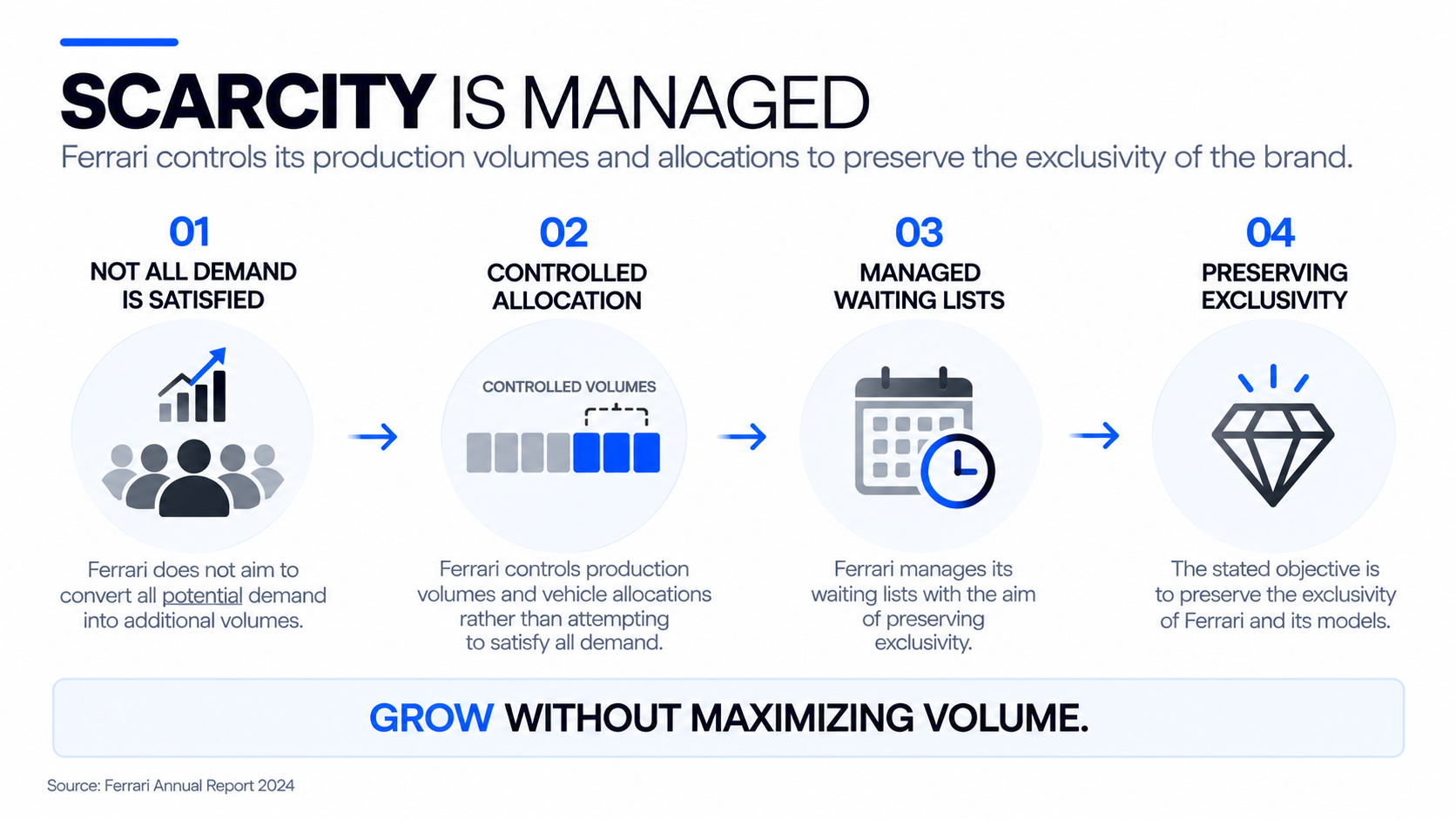
The company could try to meet a much larger share of demand by sharply increasing production. Instead, it chooses to control its volumes.
That choice is part of its strategy: Ferrari aims to grow while maintaining enough scarcity to preserve the exclusivity of its cars.
The objective, then, is not to sell as few cars as possible.
It is to deliberately keep supply below the full level of potential demand.
Ferrari Does Not Aim to Maximize Volume
Ferrari describes its business model as a low-volume strategy designed to preserve the brand’s exclusivity.
That does not mean production remains fixed.
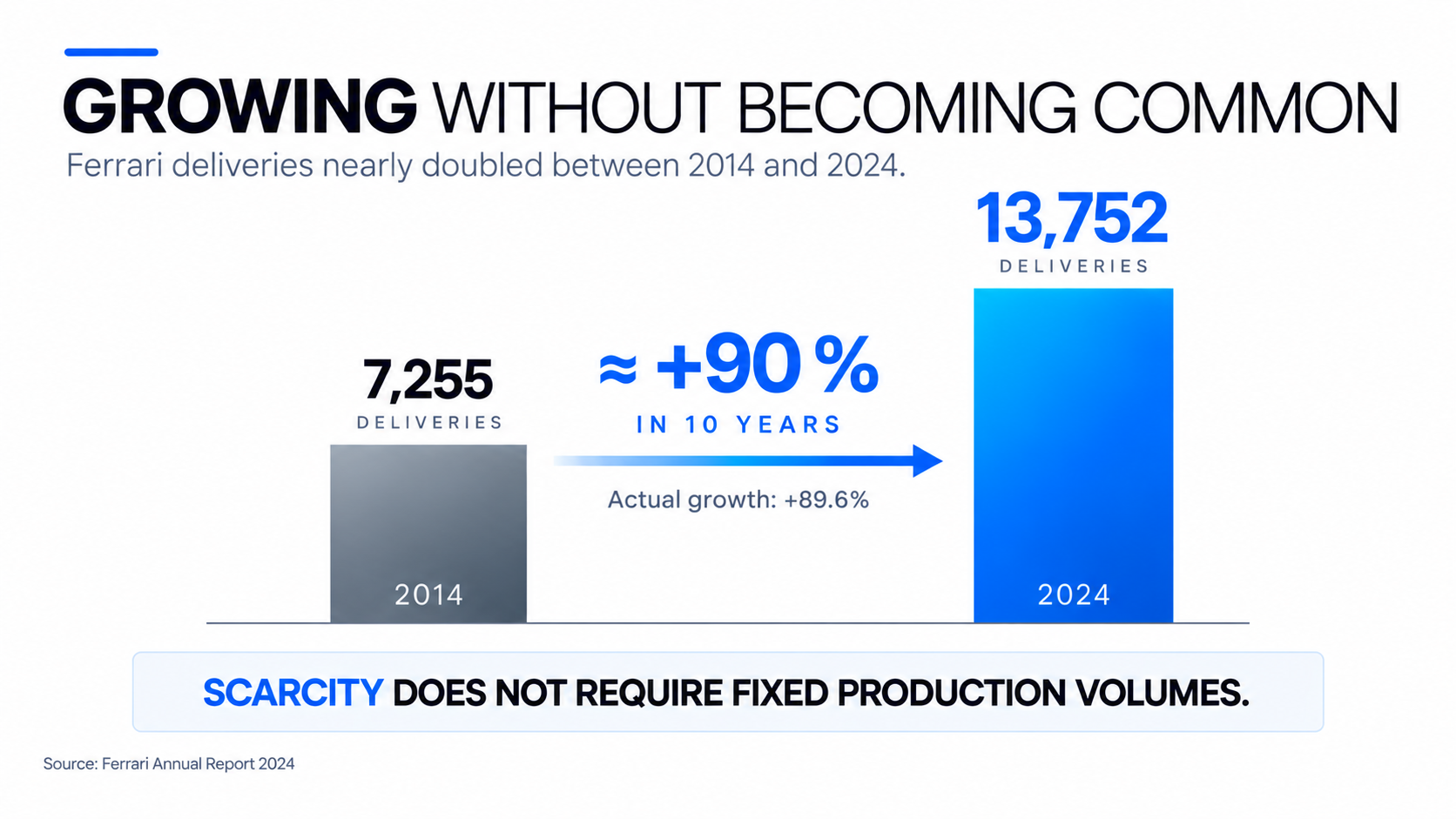
In 2014, Ferrari delivered 7,255 cars.
Ten years later, in 2024, it delivered 13,752.
Volumes therefore increased by approximately 90% over a decade.
Ferrari can gradually increase deliveries without attempting to satisfy all available demand immediately.
That distinction is essential.
Scarcity at Ferrari does not depend on an unchanging number of cars.
It depends on growth being controlled enough to maintain a gap between demand and supply.
Waiting Lists Are Part of the Equation
For many companies, a long waiting list mainly represents demand that has not yet been fulfilled.
At Ferrari, waiting lists also help preserve exclusivity.
The automaker explains that it manages allocations and waiting lists with this objective in mind.
Limited availability thus becomes part of the business model.
Having the financial means to buy a Ferrari does not necessarily mean being able to obtain the desired model immediately.
A sharp increase in production could potentially turn more inquiries into sales in the short term.
But it would also increase the number of cars available.
Ferrari therefore balances two objectives: growing and remaining exclusive.
Customers Who Keep Coming Back
This strategy rests on a particularly important characteristic of Ferrari’s customer base.
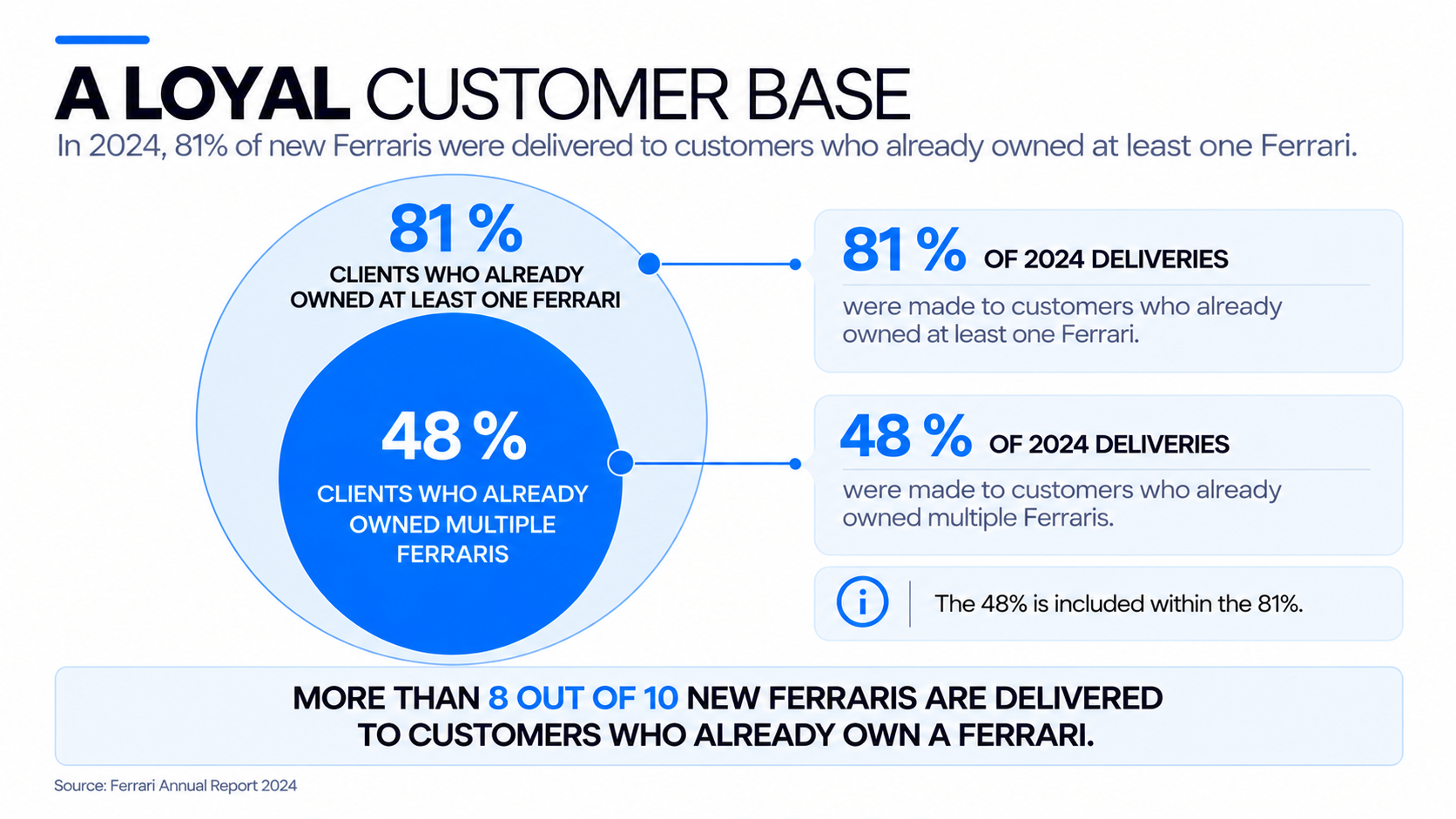
In 2024, approximately 81% of new Ferrari cars were sold to customers who already owned at least one Ferrari.
And 48% were sold to customers who already owned more than one.
In other words, a substantial share of sales comes from customers returning to the brand.
This loyalty allows Ferrari to develop different models and experiences without relying solely on a constant stream of first-time buyers.
It also helps explain why the customer relationship extends beyond a one-off car purchase.
Ferrari has built an ecosystem in which some customers can successively buy multiple models, collect them and participate in different brand programs.
Growing Without Selling More Cars
Ferrari’s 2025 financial year offers a particularly revealing illustration of this model.
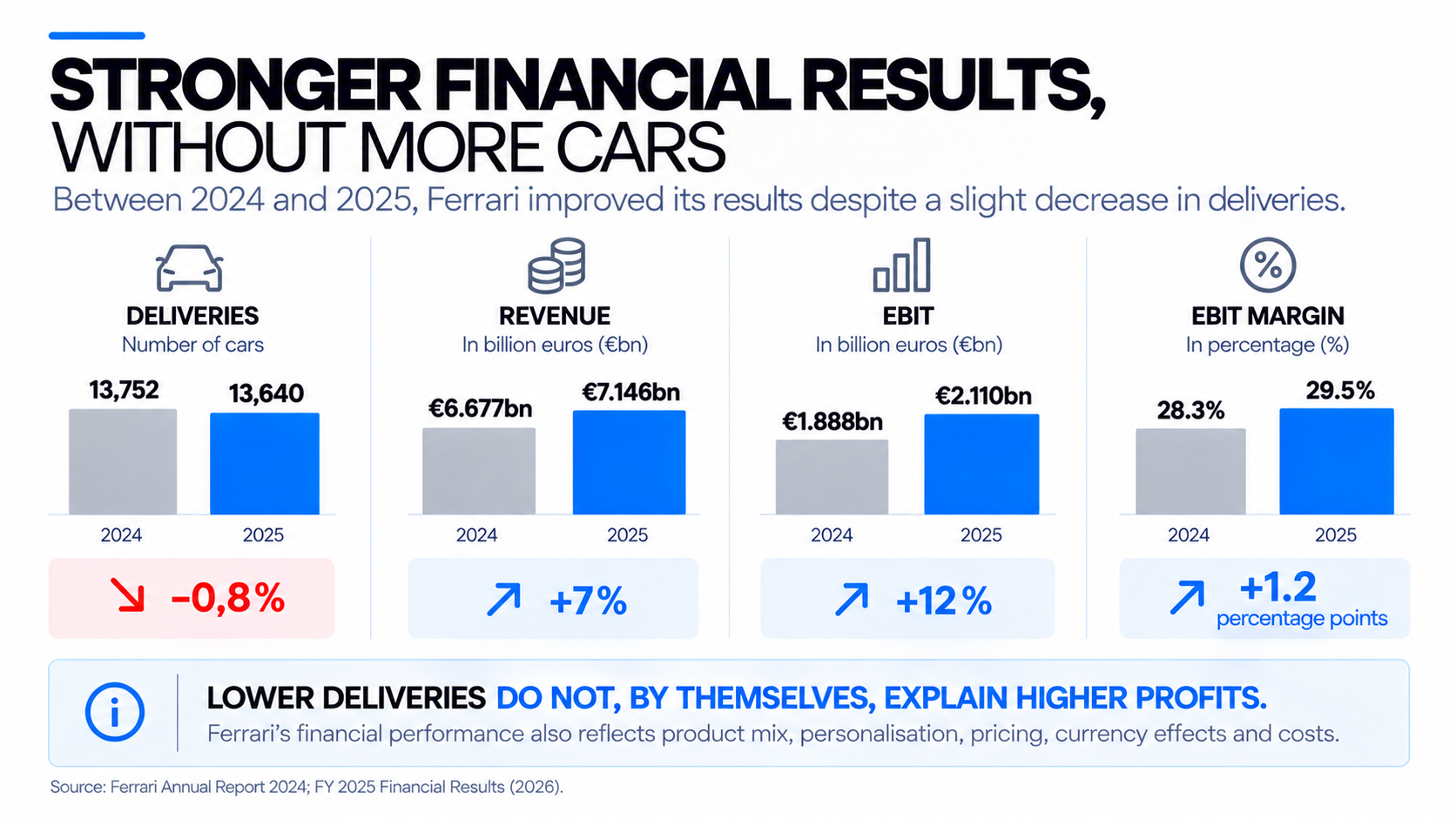
The company delivered 13,640 cars, compared with 13,752 in 2024.
Deliveries therefore declined by 0.8%.
At the same time, net revenues rose from €6.68 billion to €7.15 billion, an increase of 7%.
Operating profit (EBIT) increased from €1.89 billion to €2.11 billion, up 12%.
And the EBIT margin rose from 28.3% to 29.5%.
This does not mean that selling fewer cars caused the improvement in financial performance.
Ferrari says its results benefited, among other factors, from product mix, country mix and personalizations. The company also stated that 2025 deliveries were deliberately kept broadly flat to facilitate a significant model change-over continuing into 2026.
But these figures demonstrate something more specific:
Ferrari’s financial growth does not necessarily depend on delivering more cars.
Creating More Value per Car
This is where personalization becomes especially important.
When customers select additional equipment, materials, colors or personalization programs, Ferrari can increase the revenue associated with a car without producing an additional unit.
Model mix plays a similar role: not every Ferrari generates the same amount of revenue.
Growth can therefore come from several levers at once:
- higher volumes when Ferrari believes it can absorb them without compromising its positioning;
- a more favorable mix of models;
- and more value generated around each car sold.
Volume thus becomes one lever among several, rather than the central objective.
Scarcity Has Limits Too
Ferrari cannot simply keep reducing the number of cars it produces indefinitely.
An excessively restricted supply would eventually constrain its growth as well.
The automaker therefore gradually increases volumes, renews its range and seeks to expand its customer base while maintaining limited production for individual models.
Its balance lies between two risks.
Producing too much, and making its cars more commonplace.
Producing too little, and unnecessarily limiting its development.
The strategy is to gradually shift that boundary without eliminating the scarcity that underpins part of Ferrari’s exclusivity.
Key takeaways
- Ferrari does not seek to keep volumes fixed: deliveries increased by approximately 90% between 2014 and 2024.
- The company manages production volumes, allocations and waiting lists to preserve exclusivity.
- In 2024, approximately 81% of new Ferraris were sold to customers who already owned at least one Ferrari.
- In 2025, deliveries declined by 0.8%, while net revenues rose by 7% and operating profit by 12%.
- Ferrari can also grow through model mix and personalization, without relying exclusively on selling more cars.
Ferrari is therefore not simply trying to put more cars on the road.
It is trying to expand its business without making its cars ordinary.
Sources
The figures and strategic statements in this article come from Ferrari’s official publications: its annual report and financial results.
- Ferrari N.V. — Annual Report 2024. cdn.ferrari.com — Low-volume strategy, exclusivity, allocations and waiting lists, deliveries in 2014 and 2024, and the 81% and 48% existing-customer figures.
- Ferrari — 2025 Full Year and Fourth Quarter Financial Results (February 10, 2026). ferrari.com — Deliveries, net revenues, EBIT, EBIT margin, product and country mix, personalizations and the deliberately broadly flat 2025 deliveries during model change-over. These were described as preliminary unaudited results in the release.