Two Samsungs Under One Name
Samsung Electronics brings together several major businesses.
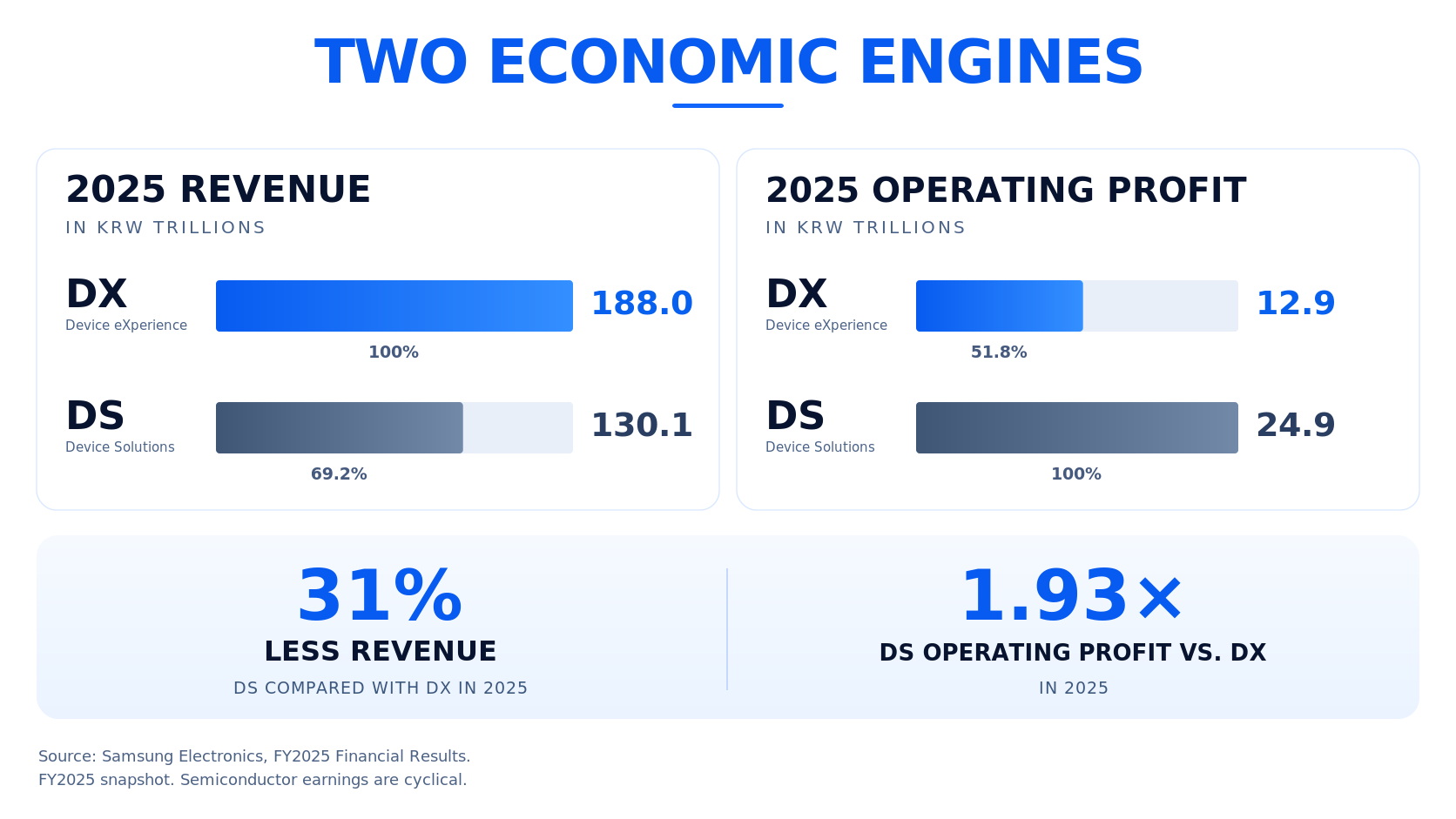
The Device eXperience division, or DX, includes Galaxy smartphones, televisions and a range of consumer devices.
Device Solutions, or DS, sits much further upstream in the value chain. This division is primarily focused on semiconductors, notably memory and foundry operations.
This difference is fundamental.
DX seeks to sell Samsung products to end consumers.
DS, by contrast, can create value by manufacturing technologies used far beyond Samsung’s own products.
Both divisions belong to the same company, but they do not depend on exactly the same customers.
A Competitor Can Also Become a Customer
This is where Samsung’s model becomes particularly interesting.
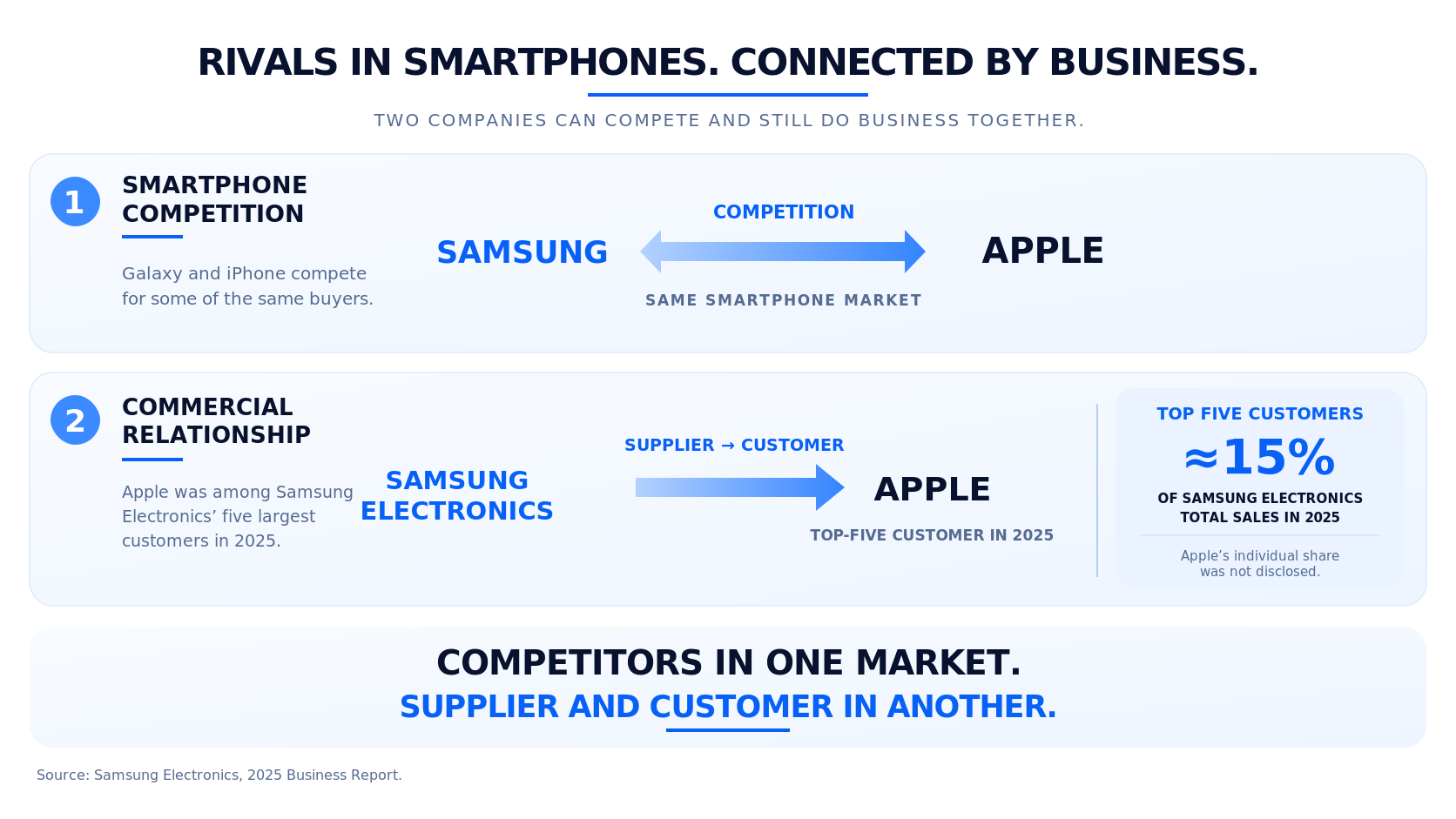
In the smartphone market, Samsung and Apple are competitors.
Galaxy and iPhone target some of the same consumers.
But this competition does not prevent a commercial relationship between the two groups at another level of the value chain.
Apple was among Samsung Electronics’ five largest customers in 2025.
Samsung states that its five largest customers together accounted for about 15% of its sales, without disclosing Apple’s individual share.
In other words, two companies can compete to sell their own products while simultaneously maintaining a supplier-customer relationship.
Why Sell Externally?
To understand this logic, you have to look at the cost of industrial infrastructure.
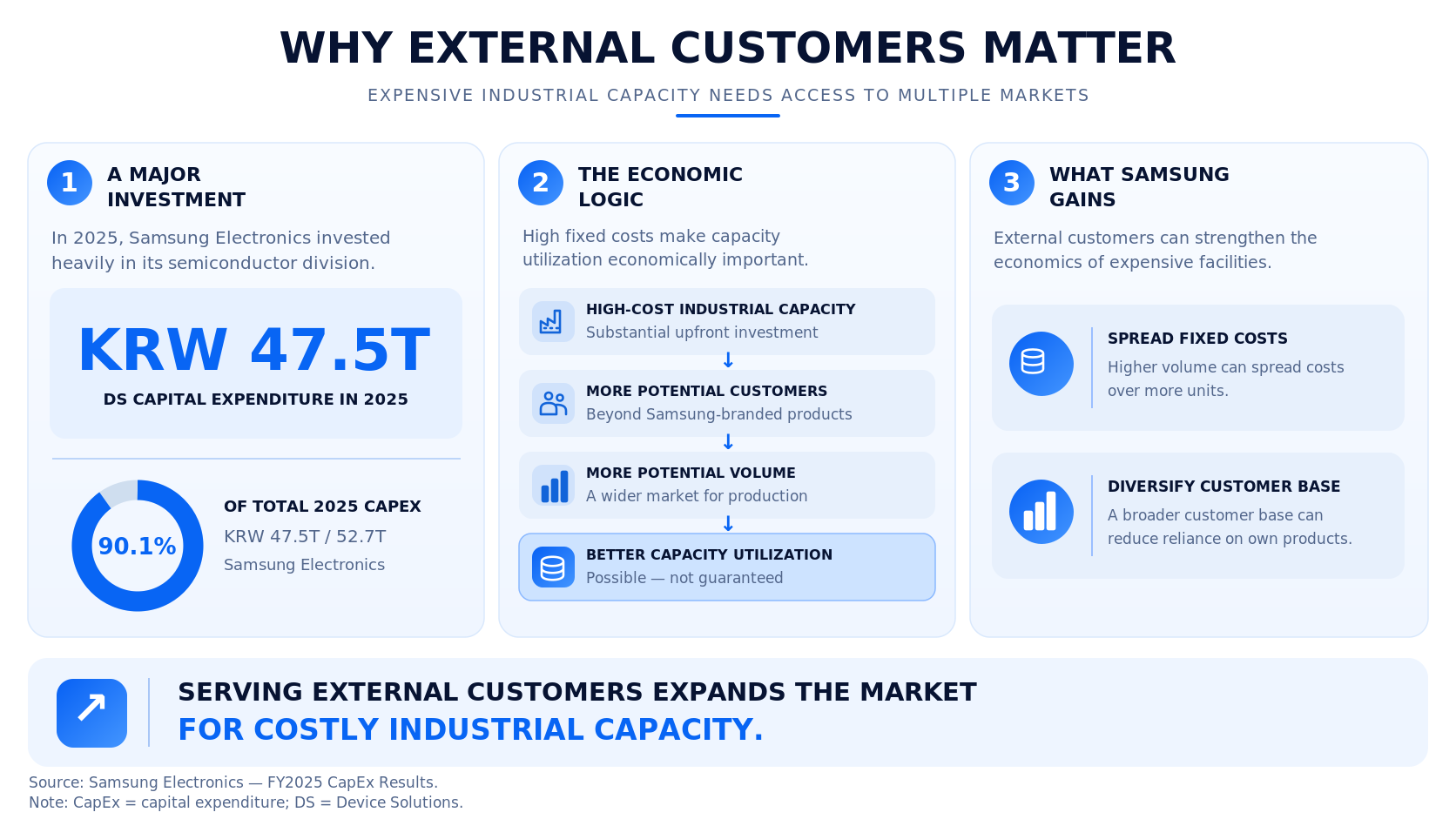
In 2025, Samsung Electronics allocated KRW 47.5 trillion in capital expenditure to its DS division.
That represents about 90% of the KRW 52.7 trillion in CapEx committed by Samsung Electronics over the year.
At this scale, manufacturing capacity represents a considerable investment and creates substantial fixed costs that must be absorbed.
Restricting sales to Samsung’s own products would inevitably narrow the potential customer base.
Conversely, serving external companies broadens the market available to this capacity.
More customers can mean more potential volume, potentially better capacity utilization and the spreading of certain fixed costs over a larger number of units.
Of course, this guarantees neither profitability nor maximum utilization.
But it explains why an industrial business can have an economic incentive to sell beyond its own group.
The Real Advantage: Being Present at Several Levels
Samsung’s model therefore does not rely solely on selling smartphones, televisions or other electronic devices.
The company is present at several levels of the value chain.
It can sell a finished product under its own brand.
It can also supply certain technologies to other manufacturers.
This position creates a distinctive economic logic: Samsung does not necessarily need to win the sale of the final product to capture part of the value created in the industry.
A device sold by another brand can therefore, in some situations, still generate revenue for Samsung at another level of the chain.
This is what makes the line between competitor, supplier and customer far less clear than it appears when looking only at finished products.
But Diversification Does Not Eliminate Risk
This diversification does not, however, make Samsung’s results stable.
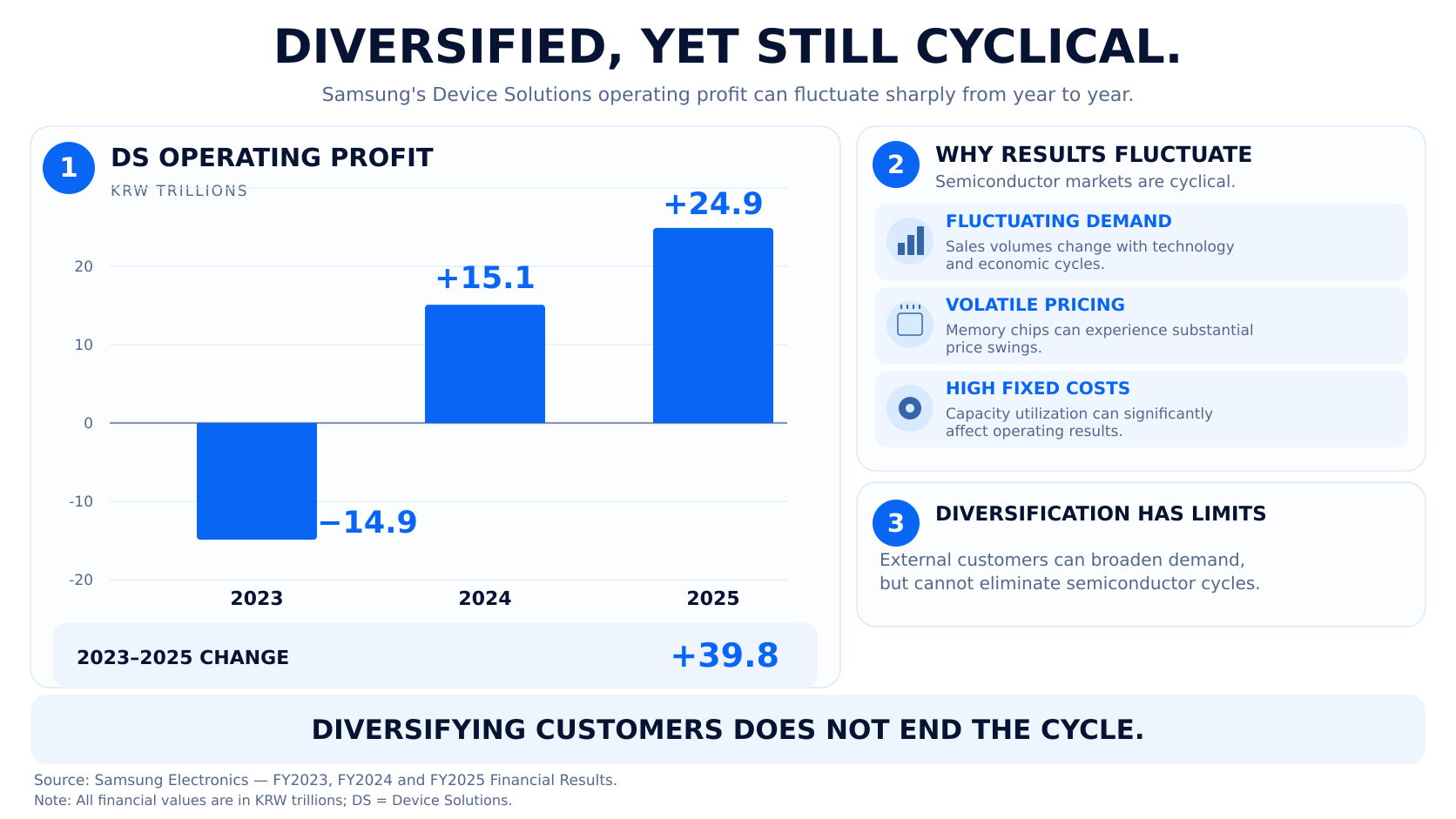
The DS division remains highly exposed to semiconductor cycles.
Its operating profit shows the scale of these swings.
In 2023, DS recorded an operating loss of KRW 14.9 trillion.
In 2024, it returned to a positive operating profit of KRW 15.1 trillion.
In 2025, operating profit reached KRW 24.9 trillion.
Between 2023 and 2025, the swing therefore amounts to approximately KRW 39.8 trillion.
Demand, prices in certain segments — particularly memory — and capacity utilization can strongly influence results.
Multiplying customers and outlets can broaden commercial opportunities.
It does not eliminate the cycle.
The Bottom Line
Samsung is not just a consumer electronics brand.
Its model also relies on industrial businesses capable of selling technologies and components to other companies.
This structure explains why a competitor in one market can become a customer at another level of the value chain.
It also makes it possible to broaden the outlets for extremely costly industrial infrastructure.
But this diversification does not make Samsung immune to cycles.
It is precisely this combination — finished products, components, external customers and industrial exposure — that explains why Samsung can compete with a company and do business with it at the same time.
Key takeaways
- DX: KRW 188.0T in revenue and KRW 12.9T in operating profit in 2025.
- DS: KRW 130.1T in revenue and KRW 24.9T in operating profit in 2025, 1.93 times more than DX.
- Apple was among Samsung Electronics’ five largest customers, which together accounted for about 15% of sales in 2025.
- KRW 47.5T, or about 90% of Samsung Electronics’ total CapEx in 2025, was invested in the DS division.
- DS operating profit went from −KRW 14.9T in 2023 to +KRW 24.9T in 2025, a swing of about +KRW 39.8T.
Sources
The figures come from Samsung Electronics’ official publications: quarterly and annual earnings presentations, and the FY2025 CapEx results announcement. The information on Apple’s presence among the five largest customers comes from Samsung Electronics’ 2025 Business Report.
- Samsung Electronics — Earnings Presentation: 4Q 2025 Financial Results. images.samsung.com — 2025 revenue and operating profit of the DX and DS divisions, and DS operating profit for 2024.
- Samsung Electronics — Earnings Presentation: 4Q 2024 Financial Results. images.samsung.com — DS operating profit for fiscal year 2023.
- Samsung Electronics — Announcement of Capex Result for FY 2025. samsung.com — Total Samsung Electronics CapEx and DS CapEx for 2025.
- Samsung Electronics — 2025 Business Report. images.samsung.com — Major customers in 2025 (Apple among the five largest) and the combined share of the five major customers (~15% of total sales).