
At Hermès, having more than €10,000 to spend is no guarantee that you can immediately buy the bag of your choice.
This gap between price, availability and demand captures much of the house’s economic power.
Hermès sells some of the most expensive objects in the luxury industry. Its prices rise regularly. Yet demand for its most sought-after models remains strong. In 2025, the group generated €16 billion in revenue, with a recurring operating margin of 41%.
The obvious explanation would be that Hermès has simply learned how to make its products scarce.
That is not enough.
Its advantage rests on a system that is far harder to replicate: savoir-faire that takes a long time to pass on, production capacity that cannot be increased overnight, largely controlled distribution, and demand strong enough to give value to limited availability.
To understand the price, then, we have to start with what makes it possible.
Hermès, far more than a Birkin
Hermès was founded in Paris in 1837 as a saddlery and harness maker. Over the generations, its business expanded into leather goods, silk, ready-to-wear, watchmaking, jewelry, perfumes and the world of the home.
Nearly two centuries later, the company is anything but a small workshop.
In 2025, it generated €16.002 billion in revenue and employed 26,494 people. Its network comprises 294 stores worldwide.
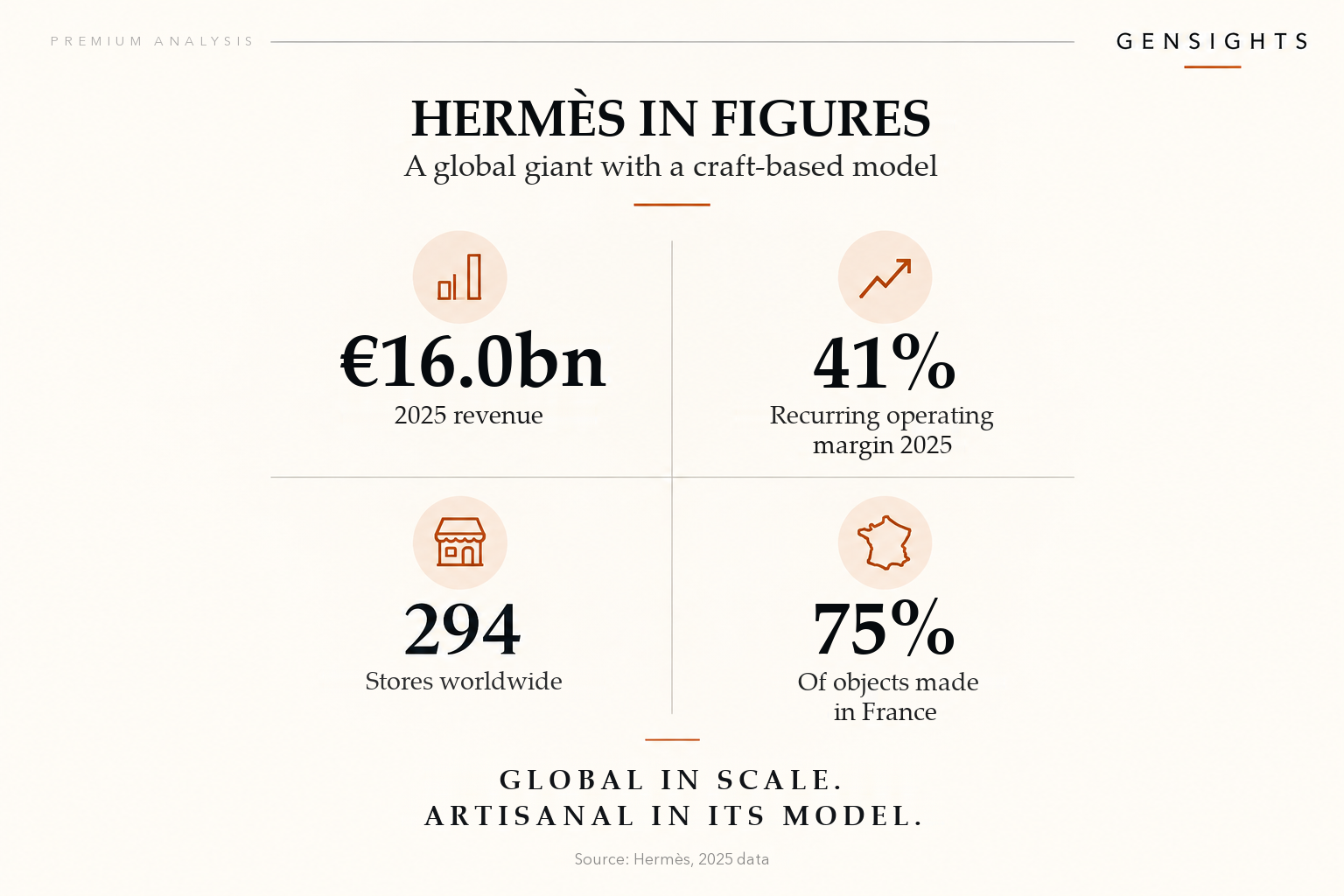
The paradox is already visible: Hermès has the scale of a global group while retaining a production model deeply rooted in craftsmanship.
It is this coexistence that makes its development so distinctive.
Making more takes time
When demand for a product exceeds supply, the standard industrial response is to increase volumes.
At Hermès, that response is more difficult.
In 2025, 55% of its objects were made in in-house and exclusive workshops, and 75% were made in France. By the end of the year, the house had more than 20 leather goods workshops organized around 10 regional hubs of expertise that bring together production units, workshops and training centers.
Increasing capacity therefore takes more than installing new machines.
It means opening workshops, recruiting artisans, training them and passing on gestures and techniques that cannot be acquired overnight. To support this growth, the École Hermès des Savoir-Faire, opened in 2021, is now deployed across 12 regional training schools.
Time also plays a role upstream. Relationships with the 50 main direct-purchasing suppliers have lasted 21 years on average. Some smaller suppliers have even worked with the house for more than 60 years.
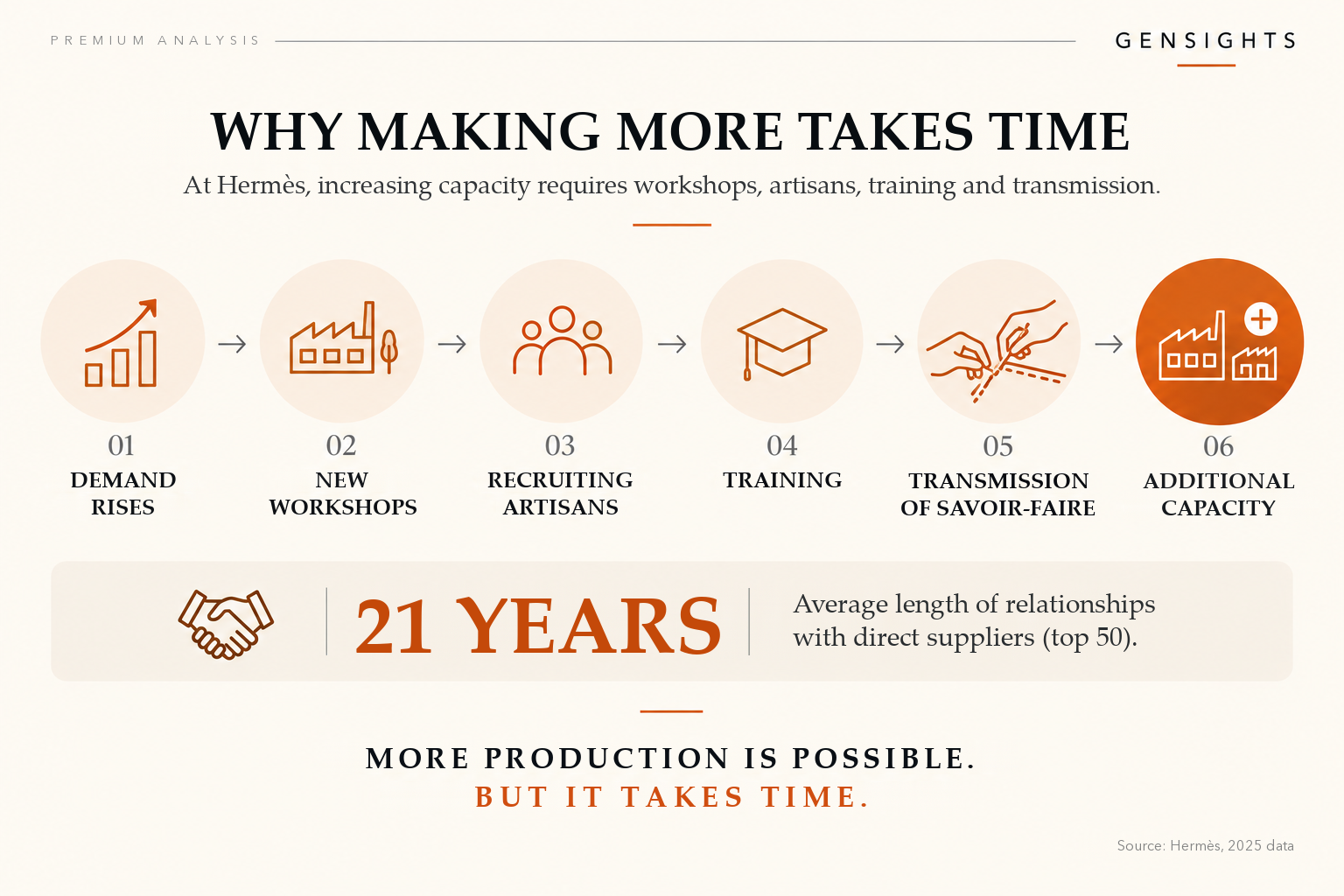
Hermès is therefore increasing its capacity. But unlike a conventional industrial production chain, that capacity cannot be added overnight.
It has to be built, recruited and passed on.
When having the money is no longer enough
This is where one of the most visible features of the model emerges.
For certain particularly sought-after models, having the necessary budget does not mean that a boutique will immediately have the exact item you want.
This reality has fueled a whole mythology around Hermès: amounts you would supposedly have to spend before obtaining certain bags, universal waiting lists, or rules said to be identical in every boutique.
These stories need to be distinguished from what can actually be established.
Hermès states that each of its 294 stores offers a personalized selection of objects, tailored to the expectations of its clientele. Its network therefore does not operate as a uniform global inventory in which every configuration would be available everywhere at the same time.
That alone is enough to create an unusual situation:
the ability to pay and the ability to buy immediately are no longer quite the same thing.
And that distinction profoundly changes the relationship to price.
Controlling the product, but also its distribution
Hermès’s control does not stop at its workshops.
It extends all the way to the place where the object meets the customer.
In 2025, more than 92% of revenue was generated through the house’s exclusive distribution network, made up mostly of branches operated directly by the group.
Hermès therefore relies relatively little on third-party distributors to present its products and manage the commercial relationship.
Production + distribution
Hermès largely controls both ends of the chain: the way a large share of its objects are made, and the environment in which they meet their customers.
This control gives the house greater command over how capacity growth, assortment, availability and price fit together across its network.
And it is precisely at this point that price becomes interesting.
From €7,000 to €10,600
According to the history of boutique prices published by Sotheby’s — historical retail prices in Hermès stores, not resale prices on the secondary market — the indicative European price of a Birkin 30 in Togo leather rose from about €7,000 in 2016 to €10,600 in 2026.
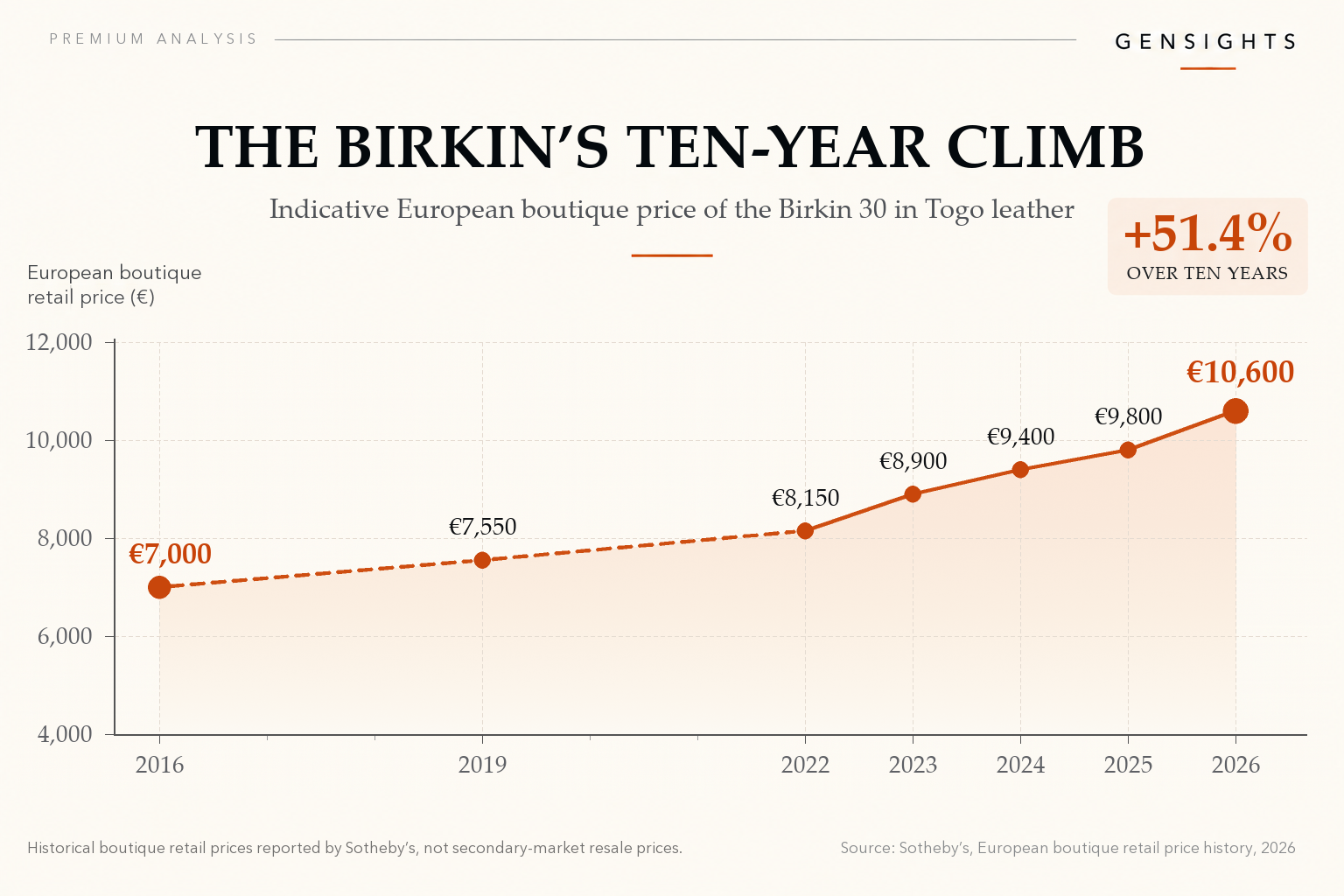
The increase is considerable.
But the decisive point is not that Hermès can display a higher price. It is that this increase has coexisted with consistently strong demand for its most sought-after models.
This does not mean that the price increases are causing that demand.
Causality runs rather the other way: a brand that already enjoys strong demand, significant differentiation and a supply that is difficult to increase quickly has more latitude to raise its prices.
That is the real issue.
The real power of Hermès
This latitude has a name: pricing power, meaning the ability to raise prices without causing a corresponding deterioration in demand or economic performance.
Hermès’s results make it possible to measure its effects.
In 2025, on revenue of €16.002 billion, the group generated €6.569 billion in recurring operating income.
That is a recurring operating margin of 41.0%.
In the first half of 2026, the recurring operating margin was still 41.0%, with €8.163 billion in revenue and €3.351 billion in recurring operating income.
These figures show an exceptional ability to preserve the profitability of the model.
They do not mean, however, that Hermès can raise its prices indefinitely without consequence.
Demand remains exposed to the economic cycle, tourism, currencies and shifts in the global luxury market.
Hermès therefore has considerable pricing power.
Not unlimited power.
That distinction is essential.
When availability itself acquires a price
The phenomenon becomes even more visible on the secondary market.
A buyer who wants a specific configuration immediately may be willing to pay more to a reseller rather than wait for an opportunity to arise in the primary network of Hermès boutiques.
The premium then no longer pays only for the object.
It also pays for immediacy and availability.
Secondary-market prices should nevertheless be interpreted with caution: they vary widely depending on the model, material, color, condition and even the sales platform. They are neither a guaranteed value nor proof that a Hermès bag would automatically be a profitable investment.
But they reveal an interesting economic phenomenon:
some buyers are no longer paying only for the object; they are also paying to be able to get it now.
Availability itself acquires a price.
Why isn’t copying Hermès enough?
At this point, the strategy might seem easy to replicate.
Produce little. Control distribution. Raise prices.
But that reading reverses the causality.
A product that nobody wants simply remains an unsold product.
Making a product scarce is easy.
Making a product scarce when customers already strongly desire it is a different matter.
That is where the difficulty of copying Hermès lies: its savoir-faire, reputation, iconic products, supplier relationships, retail network and desirability have been built up over the long term.
A competitor can raise its price tomorrow morning.
It can reduce the quantities available.
It can open spectacular boutiques.
What it cannot reproduce overnight is the system that gives those decisions their value.
Scarcity, taken in isolation, is therefore not the Hermès model.
The growth paradox
This is also where the system’s potential fragility emerges.
The more successful Hermès becomes, the more growth opportunities demand opens up for it.
But the faster the company grows, the more it must preserve precisely what allows it to stand apart.
The challenge, then, is not simply to sell more.
It is to grow without diluting what makes that growth possible.
How can it produce more without industrializing what gives its savoir-faire its value?
How can it expand its network without diluting the brand?
How far can it raise prices without eventually weakening demand?
Hermès has not eliminated the economic constraints that luxury companies face.
Its advantage lies in having built a model that gives it more room to maneuver in the face of them.
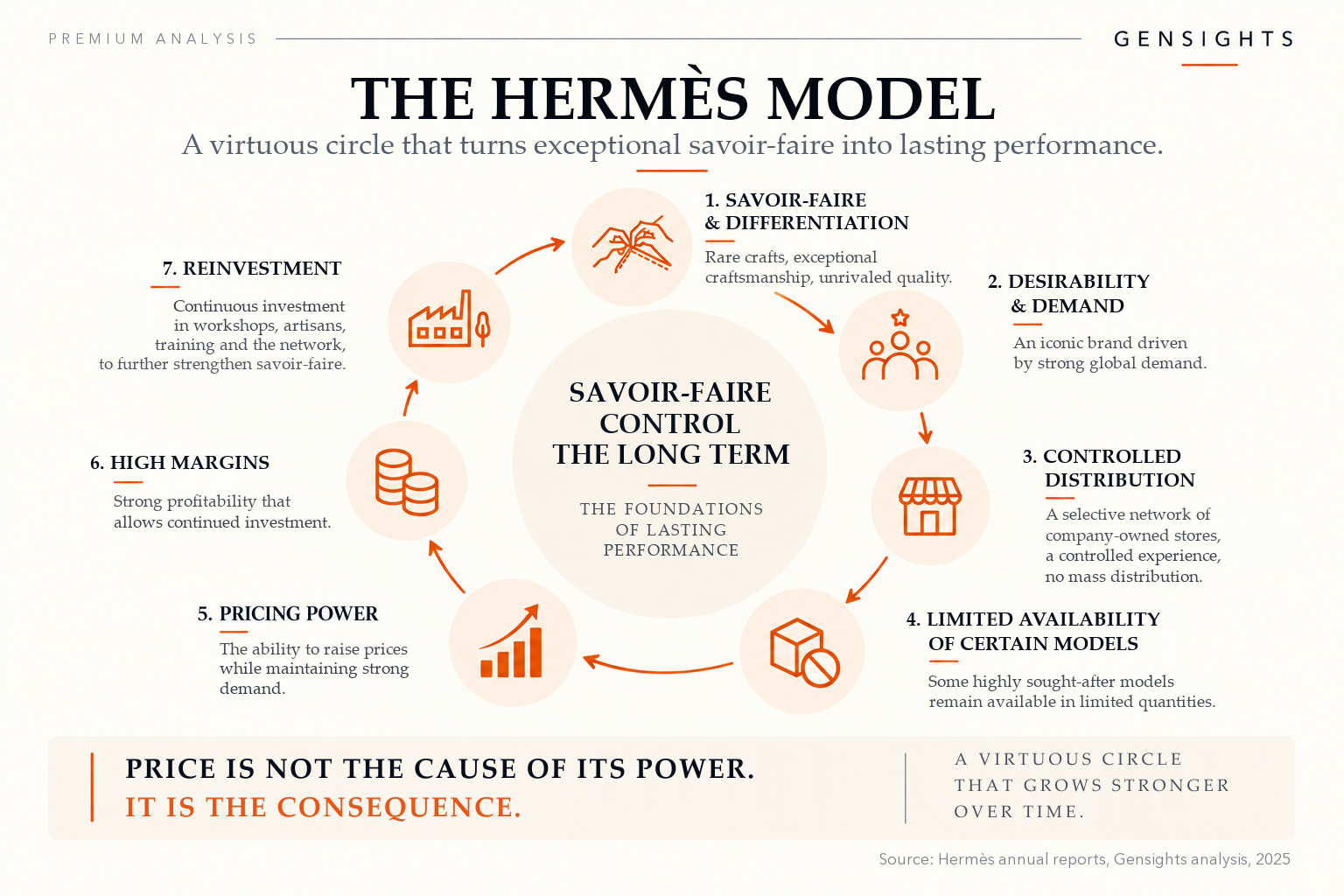
Price then appears for what it is: the visible expression of a much deeper system.
What you are really paying for at Hermès
A Hermès object is not expensive simply because the house supposedly decided to make it scarce.
Its price rests on something far harder to build: accumulated savoir-faire, production whose capacity grows slowly, largely controlled distribution and, above all, demand strong enough to give value to limited availability.
Hermès can open new workshops, train more artisans and expand its network. But each of these decisions takes time — and must be carried out without diluting precisely what customers come looking for.
That is where its true economic power lies.
Price is not the cause of its power. It is the consequence.
Key takeaways
- Hermès does more than maintain limited supply: the house is expanding its capacity, but that requires workshops, recruitment, training and the transmission of savoir-faire.
- The group largely controls both ends of its model: 55% of its objects are made in in-house and exclusive workshops, while more than 92% of revenue flows through its exclusive distribution network.
- According to Sotheby’s, the indicative European boutique price of the Birkin 30 Togo rose from €7,000 in 2016 to €10,600 in 2026, an increase of about 51.4%. This series comes from Sotheby’s, not from an official historical price list published by Hermès.
- Limited availability alone does not explain Hermès’s power. It gains its value when it meets already strong demand and differentiation that is difficult to replicate.
Sources
The financial and strategic data come from official publications by Hermès International. The retail price history of the Birkin 30 Togo comes from Sotheby’s, not from an official Hermès price list.
- Hermès Finance — Strategy. finance.hermes.com/en/strategy. Overview of the model of creation, craftsmanship and exclusive distribution.
- Hermès Finance — Key figures. finance.hermes.com/en/key-figures. Revenue, recurring operating income, headcount and store network.
- Hermès Finance — Materials and supply chains. finance.hermes.com/en/materials-and-supply-chains. Organization of the workshops, share of in-house manufacturing and of manufacturing in France.
- Hermès Finance — Partners and suppliers. finance.hermes.com/en/our-partners-and-suppliers. Length of relationships with the main suppliers.
- Reuters — “Hermes sales rise, with US prices rising 5% more than elsewhere,” July 30, 2025. reuters.com. Market context, performance and competitive environment in the luxury sector, 2025–2026.
- Sotheby’s — published retail price history of the Birkin 30 Togo. sothebys.com — Hermès Raises the Birkin Bag Price. A secondary-market player that notably publishes a history of Birkin retail prices; these data are distinct from official Hermès prices.