In October 2025, Apple’s market capitalization crossed the symbolic $4 trillion threshold for the first time.
The figure is spectacular. It can also be misleading.
A $4 trillion market capitalization does not mean Apple has $4 trillion in the bank. It is the value investors collectively assign to all of its shares — and, behind that value, their expectations for the profits the company can generate in the years ahead.
That is where the real question lies. How did a company founded in 1976, one that came close to disappearing in the 1990s, become one of the most valuable companies in history?
The answer is not the iPhone alone, nor marketing, nor Steve Jobs, but a combination of mechanisms: a vast user base, an integrated ecosystem, fast-growing Services, high margins and an exceptional ability to turn revenue into cash.
Apple’s valuation does not simply reward what the company sells today. It reflects the market’s confidence that Apple can keep the machine running tomorrow.
Twenty-five years to change scale
In the early 2000s, Apple was nothing like the financial heavyweight it would become. Its market value was measured in billions of dollars. Then, step by step, the company changed scale: Mac, iPod, iPhone, App Store, Services, Apple silicon…
The milestone came on October 28, 2025, when a rise in the share price during trading briefly lifted Apple’s market value above $4 trillion. Only two public companies had reached that level before. The change of scale had taken about twenty-five years.
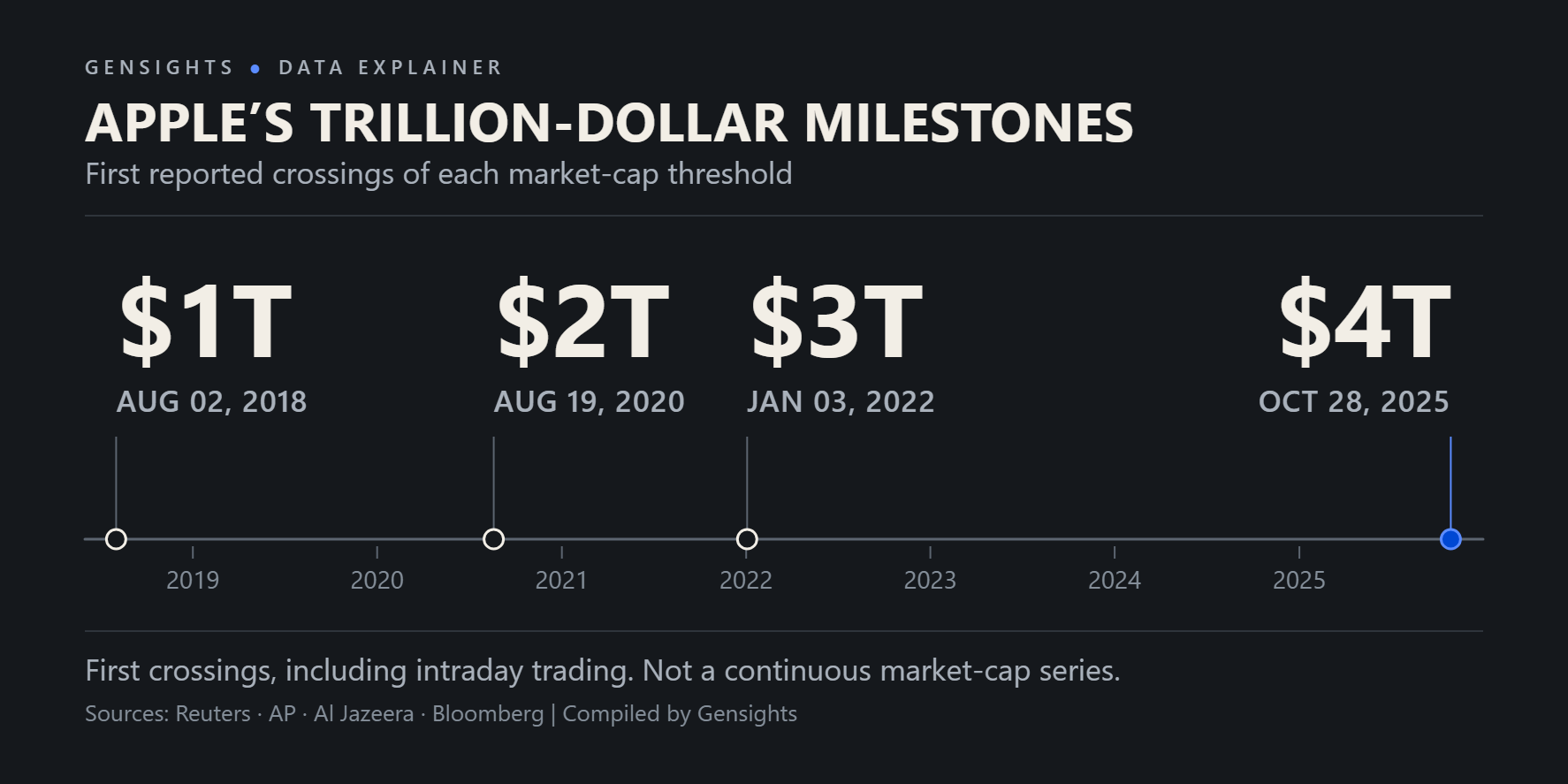
That trajectory is all the more striking given where Apple was coming from.
Yet Apple nearly disappeared
In the mid-1990s, Apple was in deep crisis. Steve Jobs had left the company in 1985. In the years that followed, its product line sprawled, its strategy lost coherence and its finances deteriorated.
In 1996 and 1997, the losses became severe. Apple cut jobs and had less and less financial room to maneuver.
The claim that Apple was “90 days from bankruptcy” has since become famous. It is best read as a retrospective description of how fragile the company had become, not as a precisely documented accounting countdown.
Then came a decisive move: Apple acquired NeXT, the company Steve Jobs had founded after leaving. Jobs gradually took back the helm.
His first major decision was not to rush out a dramatic new product. It was to simplify. Apple pared back its product line, dropped projects, concentrated its resources on a handful of products and set out to recover a clear identity.
In August 1997, Microsoft also announced a $150 million investment in Apple, as part of a broader agreement that included continued development of Microsoft Office for the Mac.
The iMac arrived in 1998. Mac OS X, the Apple Stores and the iPod then opened a new chapter.
Apple was no longer merely surviving.
It was beginning to rebuild a system.
From good products to a machine that creates markets
The iPod, launched in 2001, illustrates the method that would define Apple for decades to come. Apple did not just build a music player. It brought hardware, software and digital distribution together in a single, coherent experience.
Then came the iPhone. Unveiled in January 2007, it gradually turned the mobile phone into a personal computing platform.
A year later, the App Store added another layer: third-party developers could now build their own businesses on Apple’s platform.
That shift transformed the business model. Each new device could reinforce the others. Each new user expanded the platform. And each additional service created another way to monetize an installed base that was already enormous.
The iPhone, however, remained the center of gravity of this architecture.
The iPhone is still Apple’s economic core
In fiscal 2025, Apple generated $416.2 billion in revenue. The iPhone accounted for $209.6 billion of it, or about 50.4%. In other words, more than fifteen years after the smartphone boom, roughly one of every two dollars Apple brings in still comes directly from the iPhone.
Services brought in $109.2 billion, Mac $33.7 billion, Wearables, Home and Accessories $35.7 billion and iPad $28.0 billion.
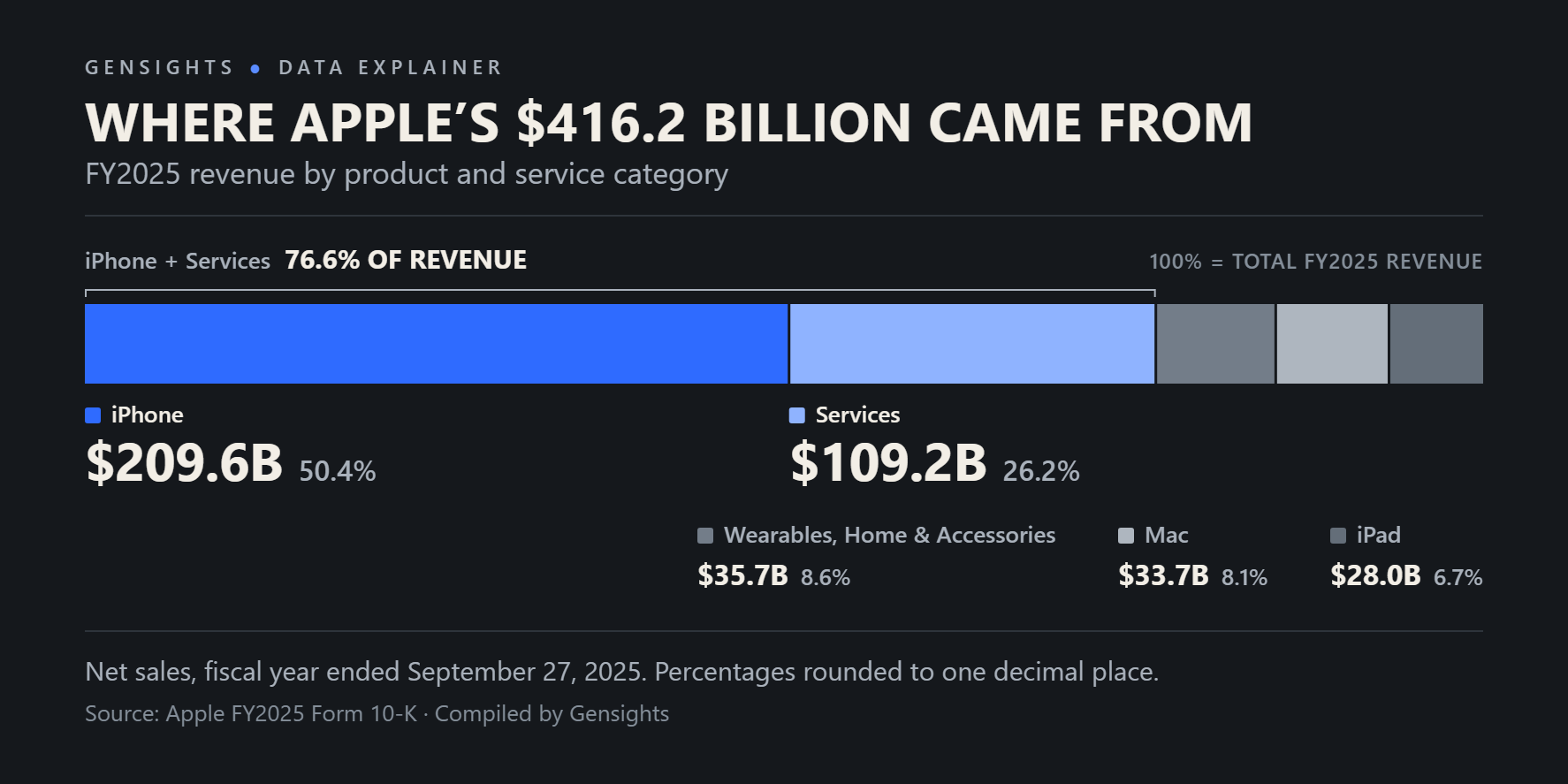
This reliance on the iPhone is both a strength and a risk. But looking only at iPhone sales would miss why the market values Apple so highly. The iPhone is not just a product. It is the main gateway into a much larger system.
Apple’s real advantage: its ecosystem
A user might start with an iPhone. Then add AirPods. An Apple Watch. A Mac. An iPad.
With iCloud turned on, their photos, messages and passwords can stay in sync. Many apps and subscriptions carry over from one device to another, and a task started on an iPhone can often be finished on a Mac. Services such as the App Store, Apple Music and AppleCare sit on top of the hardware.
Individually, each of these elements faces competition. Their strength lies in how they work together.
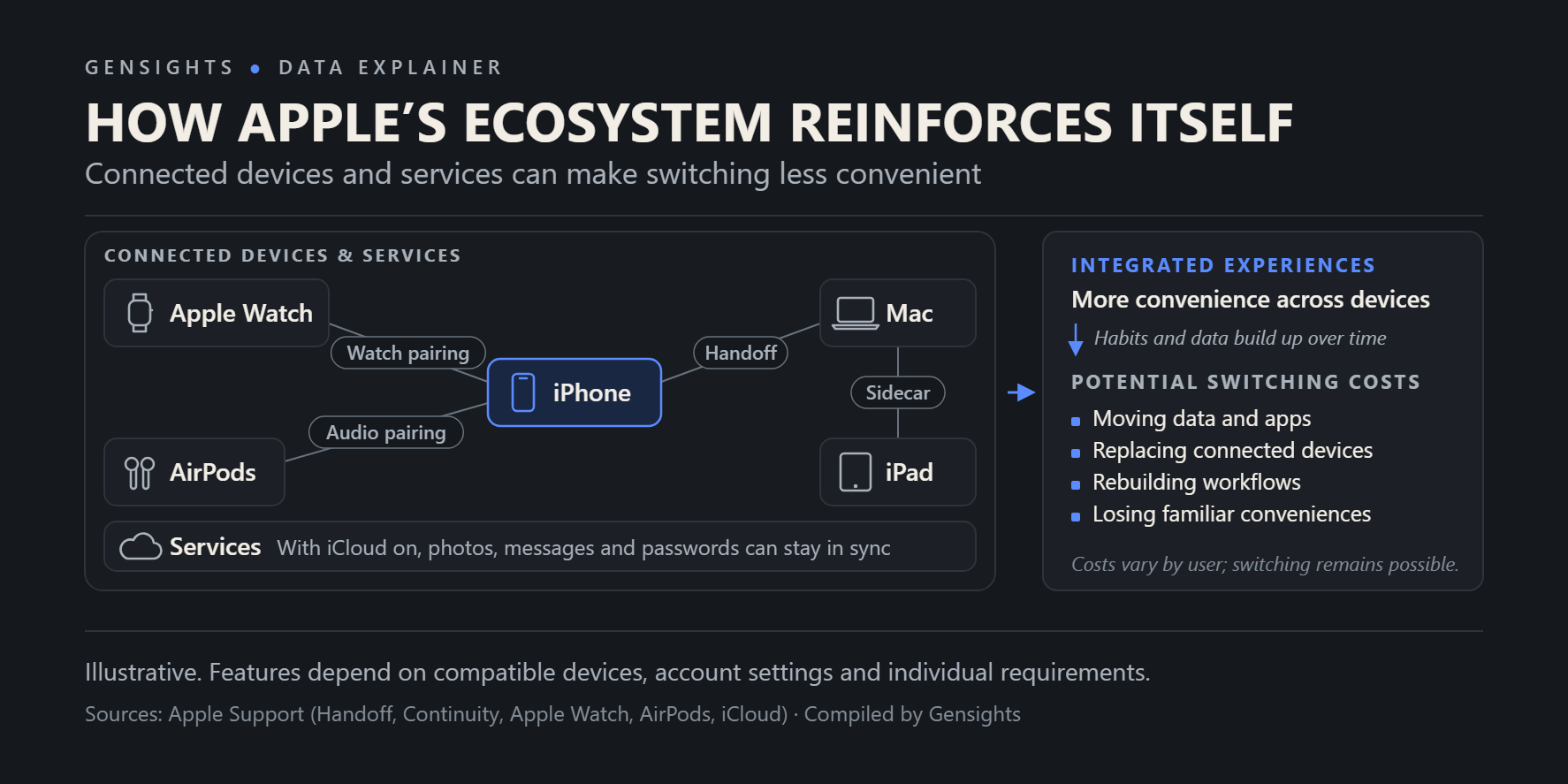
The more Apple devices a user owns, the more leaving can mean replacing several of them, moving data, finding apps again, changing habits and sometimes giving up familiar routines.
This is what is known as a switching cost. It does not stop anyone from leaving. It simply makes leaving progressively more cumbersome.
That is one reason the loyalty of Apple’s installed base matters so much economically: the company does not have to win back its entire customer base with every product generation. It can keep selling those customers hardware — and services too.
Services changed Apple’s economics
In fiscal 2025, Services generated $109.2 billion, up from $96.2 billion a year earlier, an increase of about 13.5%. That is already more than a quarter of total revenue.
Their importance goes beyond their share of sales, however. In fiscal 2025, Apple’s gross margin was 36.8% on products and 75.4% on Services. As a result, Services, at just over a quarter of revenue, produced about 42% of Apple’s total gross margin.
This is where the model becomes particularly powerful. Hardware attracts and retains a huge user base. That base then uses digital services. Those services generate new revenue without Apple having to sell a new iPhone with every transaction.
The shift is fundamental, but not automatic. When Services outgrow products, as they did in fiscal 2025, the mix tends to lift Apple’s overall gross margin, although weaker product margins or regulatory changes can offset that effect. Apple is still a products company; its economics simply depend less exclusively on the next device it sells.
Margins, cash and buybacks: the financial machine
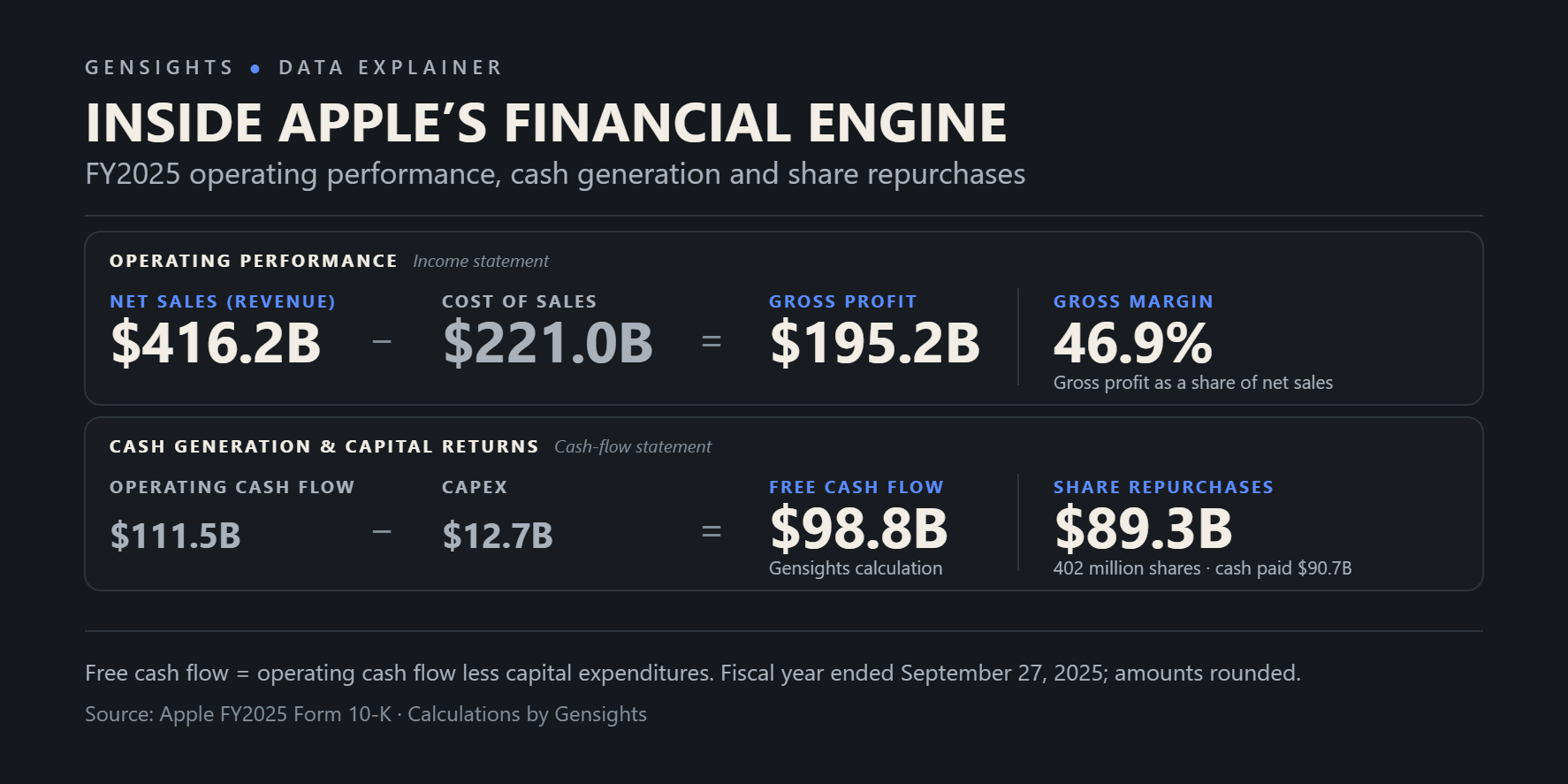
Apple’s $416.2 billion in fiscal 2025 revenue produced about $195 billion in gross margin, or roughly 47% of sales. Net income came to about $112.0 billion.
Cash generation was just as striking. Apple generated about $111.5 billion in operating cash flow over the year. After about $12.7 billion in capital expenditures, that leaves free cash flow — on this simple measure — of about $98.8 billion.
That financial strength allows Apple to invest, reward shareholders and buy back its own stock on a very large scale. Over fiscal 2025, the company repurchased about $89.3 billion of its own shares.
Buybacks have an important mechanical effect. When a company reduces the number of shares outstanding, the same profit is divided among fewer shares. All else being equal, earnings per share rise.
That does not guarantee a higher share price. But combined with strong profit and cash generation, the mechanism helps explain why buybacks play such a central role in Apple’s financial machine.
So why does the market accept such a valuation?
None of these elements is enough on its own. The iPhone is extremely profitable, but other companies make excellent smartphones. Services generate substantial revenue, but Apple is hardly the only company selling subscriptions. The brand is powerful, but a brand alone does not produce $100 billion in cash a year.
What the market values is the combination. Apple has a vast installed base of active devices. And it controls, all at once, much of the hardware, the operating system, software distribution and the services built around those devices.
The iPhone captures a major share of the economic value.
The ecosystem raises the cost of leaving.
Services monetize the relationship beyond the initial purchase.
Margins turn sales into profits.
Cash generation gives Apple exceptional room to invest and allocate capital.
And buybacks steadily shrink the number of shares outstanding.
Apple has built a machine that can monetize the same customer relationship several times over — device, accessories, services, upgrades — and then convert a substantial share of that activity into profit and cash.
But a giant valuation creates giant expectations
Dependence on the iPhone
With about 50% of fiscal 2025 revenue, the iPhone remains large enough that a lasting slowdown in this franchise would weigh heavily on Apple.
Regulatory pressure
Part of the ecosystem’s economic strength comes precisely from the control Apple exerts over its platform. That control also faces regulatory and legal pressure in several jurisdictions. A far-reaching change in the rules on app distribution, payments or interoperability could weaken some of the mechanisms that make the ecosystem so profitable today.
A complex supply chain
Apple depends on a global network of suppliers, and some components come from single or limited sources. That concentration is a structural risk.
The need to keep innovating
Finally, a valuation in the trillions may be difficult to sustain on existing businesses alone. Over time, it is likely to require new sources of growth as well.
Artificial intelligence is now part of that equation. Beyond AI, the challenge is broader: Apple must keep strengthening its ecosystem, develop new uses and sustain the level of profitability that justifies the market’s expectations.
The more predictable its model appears, the more value the market assigns to it.
But the higher that value climbs, the less room Apple has for error.
What the market is really buying
A $4 trillion valuation is not a prize for what Apple has already achieved.
Its track record matters mainly as evidence of what the company can do.
The valuation itself rests on the profits investors expect Apple to earn for many years to come.
In that sense, valuing Apple at $4 trillion is a wager on continuity: that users will keep upgrading and paying for services, and that the cash will continue to flow.
That is what makes such a valuation demanding.
Apple would not need to fail in order to disappoint. It would only need to grow more slowly, or less profitably, than investors had assumed.
Apple’s real achievement, then, is not a single product.
It is an economic architecture that investors believe can go on producing profit and cash long after today’s devices have been replaced.
At $4 trillion, the market was pricing the durability of the machine Apple had built.
And durability is never proven once and for all.
Key takeaways
- The iPhone generated about 50.4% of Apple’s fiscal 2025 revenue, which totaled $416.2 billion.
- Services contributed $109.2 billion, over a quarter of the company’s sales.
- Apple posted a gross margin of about 47% and about $98.8 billion in simple free cash flow in fiscal 2025.
- Share repurchases totaled about $89.3 billion in fiscal 2025.
- Apple’s climb to $4 trillion rested on a combination: the iPhone, the ecosystem, Services, margins, cash generation and capital allocation.
Sources
Fiscal 2025 figures come from Apple’s annual report filed with the SEC. Historical milestones draw on SEC filings, company press releases and contemporaneous reporting; the market-value milestones are documented by the financial press. Primary sources are listed first in each entry.
- Apple Inc. — Form 10-K for the fiscal year ended September 27, 2025 (filed with the SEC on October 31, 2025). sec.gov. Primary source for revenue by category, gross margins, net income, operating cash flow, capital expenditures and share repurchases in fiscal 2025, and for the risk factors on supply chain and regulation.
- Apple Computer, Inc. — Form 10-K for the fiscal year ended September 26, 1997 (filed with the SEC on December 5, 1997). sec.gov. Primary source for the restructuring, headcount reductions and the February 1997 acquisition of NeXT. The fiscal 1996 and 1997 net losses are as reported at the time by TidBITS: Geoff Duncan, “Apple Posts Quarterly… Profit!,” October 21, 1996; Adam Engst, “Apple Posts $161 Million Fourth Quarter Loss,” October 20, 1997.
- Microsoft — “Microsoft and Apple Affirm Commitment to Build Next Generation Software for Macintosh,” press release, August 6, 1997. news.microsoft.com. Agreement announced at Macworld Boston, including future versions of Microsoft Office for the Mac and a $150 million investment in non-voting Apple stock.
- Apple — Newsroom press releases. “Apple Presents iPod,” October 23, 2001 (iPod launch); “Apple Reinvents the Phone with iPhone,” January 9, 2007 (iPhone unveiling); “iPhone 3G on Sale Tomorrow,” July 10, 2008, and “iPhone App Store Downloads Top 10 Million in First Weekend,” July 14, 2008 (App Store launch).
- Market-value milestones. Subrat Patnaik, “Apple Becomes Third Stock in History to Top $4 Trillion in Value,” Bloomberg News (via Bloomberg Government), October 28, 2025, for the intraday milestone; Dan Caplinger, “Apple’s $3 Trillion Journey,” The Motley Fool, February 24, 2022, for Apple’s far smaller market value in earlier decades.