In 2011, CATL had only just been founded.
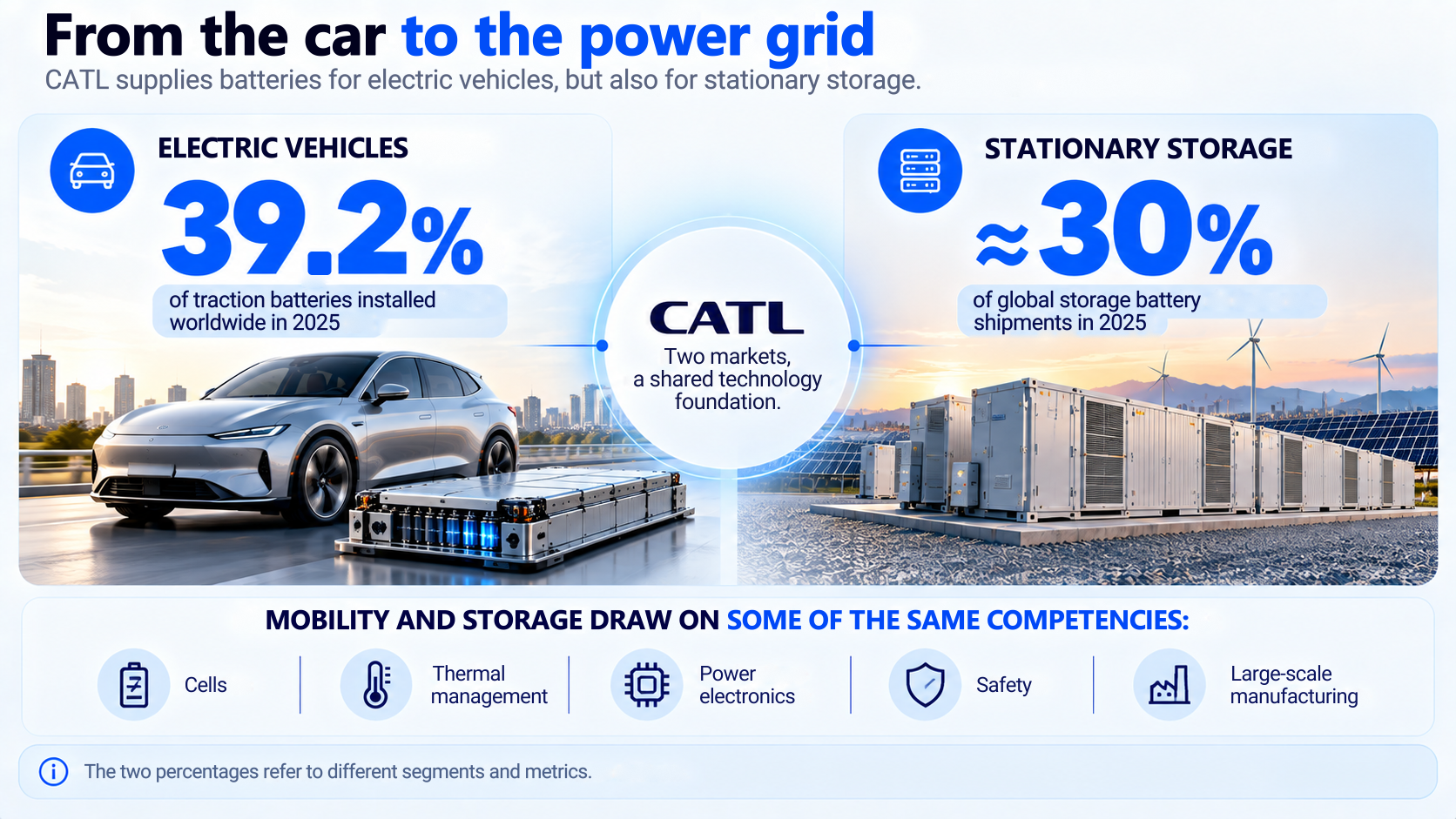
Fourteen years later, the Chinese company accounted for 39.2% of the global market for batteries installed in electric vehicles.
In other words, nearly four of every ten kilowatt-hours of traction batteries installed worldwide in 2025 came from CATL. The company remained the world leader, well ahead of its competitors.
But that dominance is not simply the result of a better battery.
An automotive battery is a complex industrial system. Its chemistry must be developed, its cells manufactured and assembled, their temperature controlled, their charging and aging managed and their safety guaranteed — and all of it must be produced in vast volumes at consistent quality.
Over time, CATL has brought all of these capabilities together.
So its advantage does not come from a single invention.
It comes from an industrial machine capable of turning several battery technologies into products manufactured at enormous scale.
A battery is more than a cell
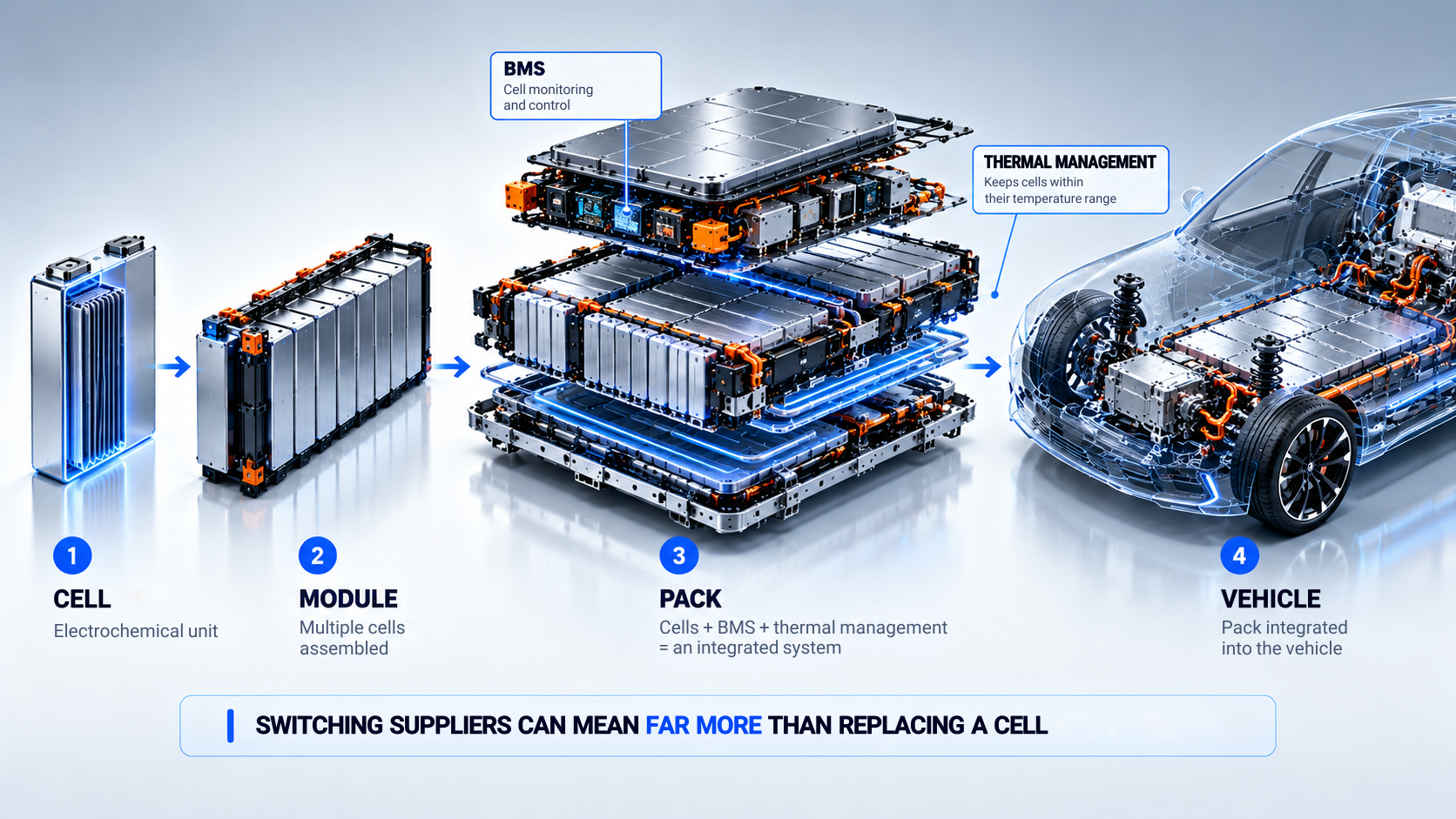
The cell is where the energy is stored.
But a cell alone does not make an automotive battery.
Hundreds of cells have to work together. Their temperature has to be controlled. Their charging and discharging have to be monitored. And the whole system has to withstand vibration, shocks and temperature swings for years.
CATL operates at several levels of this architecture: cells, modules or module-free designs, packs and battery management electronics.
With its Cell-to-Pack technology, followed by Cell-to-Chassis, the company has also sought to eliminate some of the intermediate layers and integrate cells more directly into the pack or the vehicle.
That shift changes the relationship with the automaker.
When a vehicle is developed around a specific battery architecture, switching suppliers no longer necessarily means buying an equivalent cell elsewhere.
Mechanical, thermal, electronic and software integration must be taken into account as well.
As a result, CATL no longer supplies just a component.
It helps shape part of the vehicle’s energy architecture.
Then CATL scaled up
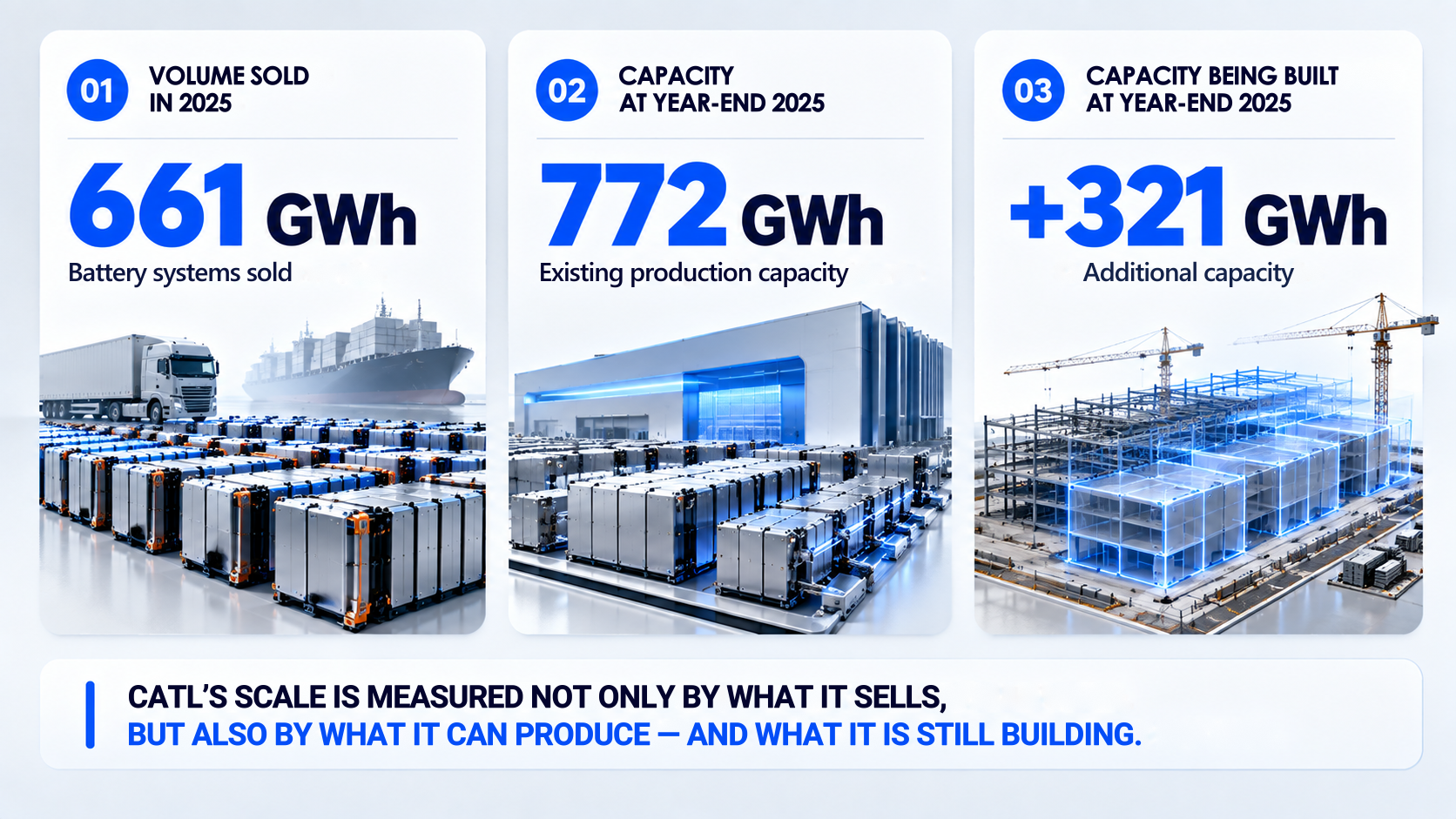
In 2025, CATL sold 661 GWh of battery systems, up from 475 GWh a year earlier.
By year-end, its production capacity had reached 772 GWh.
And a further 321 GWh was still under construction.
These figures give a sense of the industrial system CATL has built.
But scale is not just about producing more.
A battery plant has to turn out immense volumes of cells with almost identical characteristics. A tiny variation in a material, a coating, an assembly step or a thermal process can become significant when it is repeated millions of times.
Producing at scale therefore means learning to control production at scale.
Volume also helps spread industrial investment and fund new product generations.
CATL thus benefits from a mechanism that is hard to replicate quickly:
more production generates more industrial experience; that experience makes the next ramp-up easier; and each ramp-up, in turn, pushes volumes higher.
Crucially, CATL did not bet on a single battery
An affordable city car, a long-range sedan, a truck and an energy storage installation do not have the same needs.
Cost, energy density, charging speed, lifespan and cold-weather performance all involve different trade-offs.
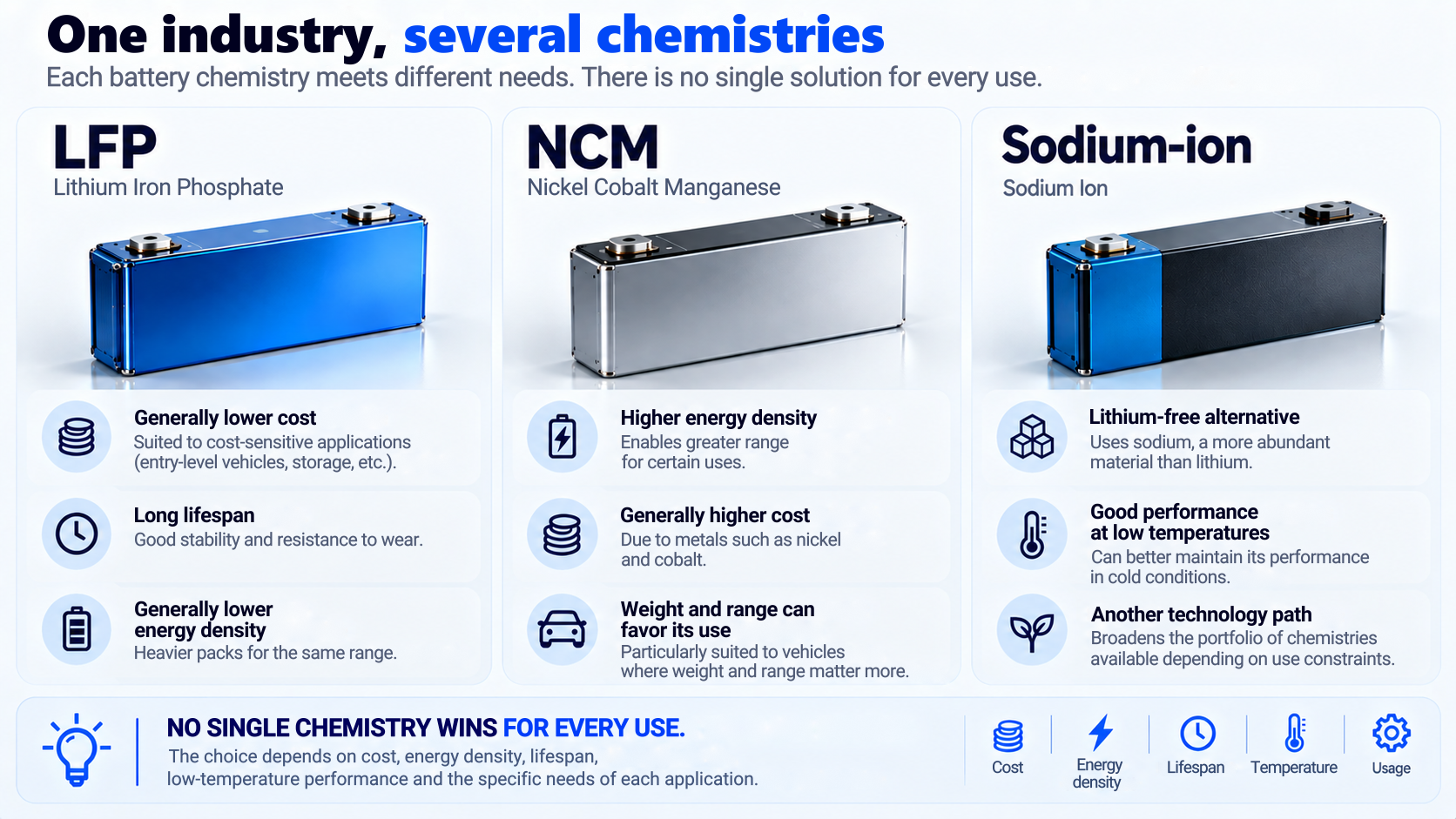
CATL therefore develops several families of technology.
LFP batteries emphasize cost, lifespan and safety, among other qualities.
Ternary chemistries, including NCM, make it possible to reach higher energy densities for certain applications.
And CATL is now pursuing a third path: sodium-ion.
With Naxtra, the company is seeking to industrialize a battery that replaces lithium with sodium for certain applications and that offers notable advantages at low temperatures.
CATL goes further still, combining different chemistries within certain battery architectures.
That changes the logic.
The goal is no longer necessarily to find the best battery.
It is to have several technologies on hand and choose the one best suited to each constraint.
This is a significant industrial advantage: if the market shifts from one chemistry to another, CATL aims to remain a supplier either way.
The real challenge begins after the lab
A new chemistry can work in an experimental cell without being ready to be manufactured by the millions.
Between a lab innovation and a battery installed in a car lies the entire industrialization process.
Materials have to be reproducible.
Processes have to be fast enough.
Defect rates have to stay low.
Safety has to be proven.
And performance has to remain consistent from one cell to the next.
This is where CATL brings research and production together.
Its scale allows it to fund research on materials, cells, pack architectures and manufacturing processes simultaneously.
Above all, it has the factories needed to turn that research into production, step by step.
That distinction is essential.
In the battery industry, inventing a technology and knowing how to mass-produce it are two separate problems.
CATL aims to master both.
Automakers have reinforced this system
As CATL grew, its batteries found their way into vehicles from a wide range of automakers.
The company works with major automotive groups in China, Europe and beyond.
Each integration requires technical validation, adaptation to vehicle platforms and the ability to deliver volumes over several years.
The result is an industrial relationship that runs deeper than a simple component order.
CATL is now seeking to bring its production capacity closer to these customers.
Beyond its home base in China, the company has been building an industrial footprint in Europe, notably in Germany and Hungary.
A new phase is now under way in Spain.
Together with Stellantis, CATL is building an LFP plant in Zaragoza with annual capacity of up to 50 GWh, as part of an investment of up to €4.1 billion. Construction officially began in November 2025.
This strategy matters.
CATL is no longer content simply to export its batteries.
It aims to bring its manufacturing know-how closer to the world’s major automotive markets.
And now CATL is moving beyond the car
Batteries are also becoming part of the infrastructure of the power system.
Solar and wind power is not always generated when it is consumed.
So it has to be stored.
And that market is now large enough to form a second industry for battery makers.
In 2025, around 550 GWh of batteries for stationary storage were shipped worldwide.
CATL accounted for 167 GWh of them, according to SNE Research.
That is around 30% of the global market, which also made the company the leader in this industry.
CATL is therefore in an unusual position.
It ranks first worldwide both in traction batteries for electric vehicles and in batteries for stationary storage.
The technologies are not used in exactly the same way.
But they draw on many of the same core competencies: chemistry, cells, thermal management, electronics, safety and large-scale manufacturing.
That allows the company to reuse part of its know-how across several markets.
The more important CATL becomes, the more its customers look for alternatives
Yet this position creates a paradox.
A company that supplies nearly 40% of the world’s traction batteries inevitably becomes a strategic concern.
Automakers want to secure their supply chains.
Governments want to build local capacity.
And several regions are trying to reduce their reliance on a battery value chain that is heavily concentrated in China.
CATL’s current dominance is therefore not guaranteed.
Its competitors keep investing.
New chemistries could reshape existing advantages.
And industrial policy could encourage the development of alternative capacity.
CATL’s international expansion can itself be seen as a response to this new reality.
Producing in Europe with local partners brings it closer to automakers and their markets.
But it also shows that competition is no longer just technological.
It is becoming industrial and geopolitical.
What is hard to replicate is not a battery
CATL can be challenged.
Its technologies can be overtaken.
And its customers can develop other suppliers.
But replicating its current position takes far more than making a good cell.
It means mastering several chemistries.
Turning those cells into complete systems.
Industrializing new technologies.
Producing several hundred gigawatt-hours.
Keeping quality consistent enough at that scale.
Working with many automakers.
Building production capacity on several continents.
And starting over whenever the technology changes.
It is this combination that explains why CATL now holds such a central place in the global battery industry.
Its advantage is not any particular battery.
It is its ability to keep turning new technologies into mass production.
Key takeaways
- CATL accounted for 39.2% of the global market for traction batteries installed in electric vehicles in 2025.
- Its advantage rests less on any single battery than on its ability to combine several chemistries, architectures and manufacturing processes.
- In 2025, CATL sold 661 GWh of battery systems, and its production capacity had reached 772 GWh by year-end.
- The company has also become the world’s leading supplier of stationary storage batteries, with around 30% of global shipments in 2025.
- What makes CATL hard to replicate is therefore the combination of technology, industrialization, scale and integration with its customers.
Sources
This analysis draws mainly on CATL’s official publications, in particular its 2025 Annual Report and its announcements on its 2025 annual results, the Naxtra sodium-ion battery and the Zaragoza LFP plant, as well as on SNE Research data on the global energy storage battery market. These sources make it possible to verify the main industrial, technological and market figures cited in this analysis.
- CATL — Annual Report 2025. catl.com. EV battery market share in 2025, sales, production capacity, capacity under construction, and industrial and financial data.
- CATL — 2025 Annual Results. catl.com. Sales of 661 GWh, R&D data and industrial development.
- CATL — Naxtra / Freevoy Dual-Power. catl.com. Sodium-ion battery, low-temperature performance and architectures combining several chemistries.
- CATL — Stellantis / Zaragoza LFP battery plant. catl.com. Zaragoza LFP plant, capacity of up to 50 GWh, investment of up to €4.1 billion and start of construction in November 2025.
- SNE Research — Global ESS battery shipments 2025. sneresearch.com. Global shipments of around 550 GWh of energy storage batteries in 2025, including 167 GWh for CATL, or around 30% of the market.