
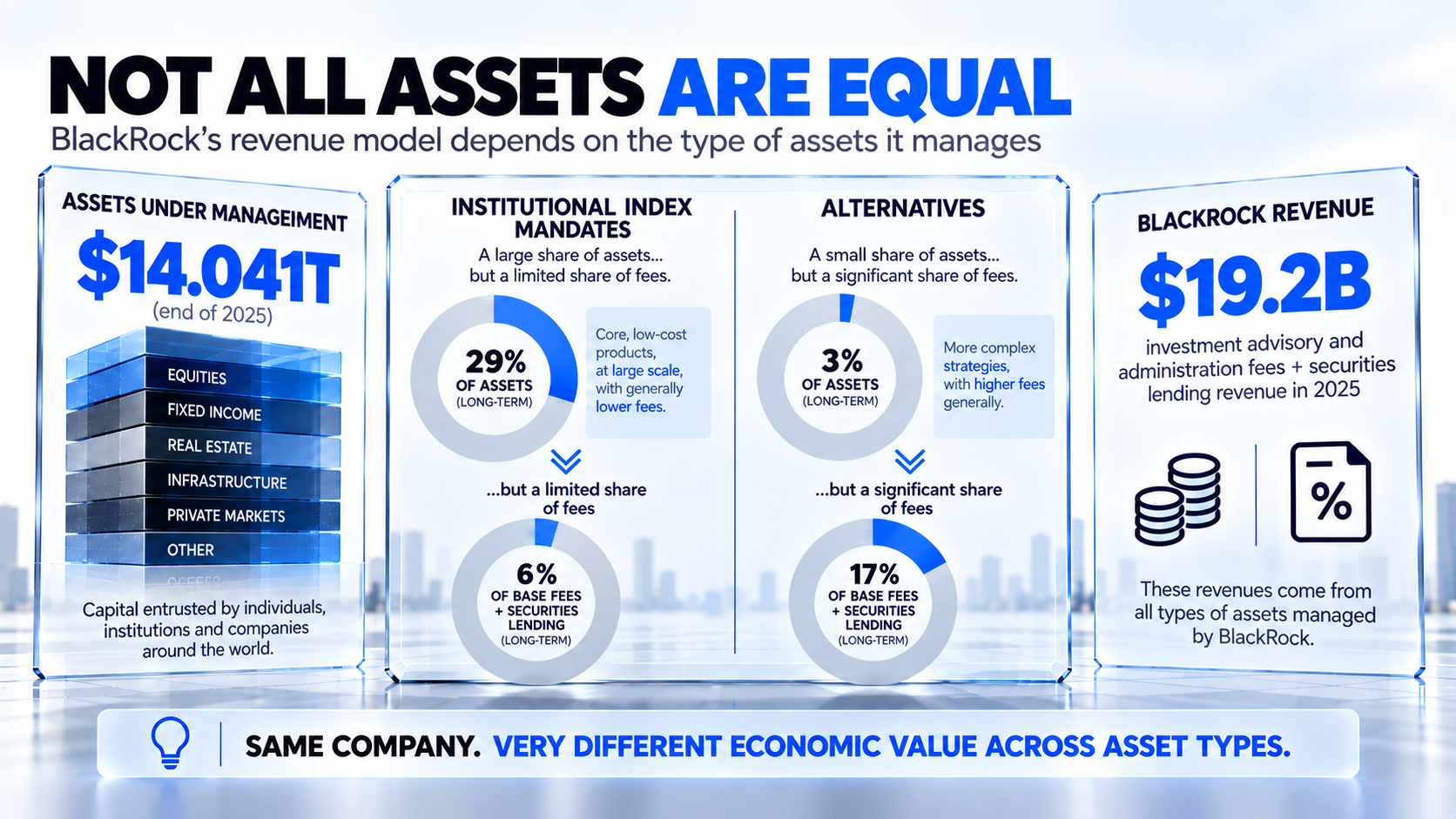
By the end of 2025, BlackRock managed $14.041 trillion in assets.
An enormous sum.
It is also one of the most misunderstood numbers in finance.
Because that $14 trillion does not belong to BlackRock.
It represents assets that individuals, pension funds, insurers, corporations, public institutions and other investors entrust to the firm through funds, ETFs and investment mandates.
BlackRock does not own this wealth.
It is paid to manage it.
The distinction is fundamental.
And it immediately changes the question.
The real issue is not simply how BlackRock came to manage $14 trillion.
It is how a firm that does not own that money became so deeply embedded in the way it is invested.

It all starts with a fairly simple mechanism
BlackRock’s first economic engine resembles that of any large asset manager.
Clients entrust it with capital.
The firm invests that capital according to a defined strategy.
And it charges fees.
The percentage may be small. But applied to several trillion dollars, the mechanism operates on an entirely different scale.
In 2025, investment advisory and administration fees, together with securities lending revenue, generated $19.2 billion.
Performance fees added roughly $1.4 billion.
But not every dollar under management is worth the same.
Institutional index mandates, for example, accounted for 29% of BlackRock’s long-term assets under management in 2025, yet only 6% of long-term base fees and securities lending revenue.
Alternatives showed almost the opposite pattern:
3% of assets, but 17% of that revenue.
In other words:
volume creates scale, but the type of asset determines part of its economic value.
The acquisition that redefined BlackRock’s scale
One event dramatically accelerated this mechanism.
In 2009, BlackRock merged with Barclays Global Investors, or BGI.
By the end of that year, the combined firm managed about $3.346 trillion, compared with $1.307 trillion for BlackRock a year earlier.
Among other things, BGI brought a vast index business and iShares, its ETF platform.
After the deal, 50% of BlackRock’s assets were invested in index products.
The acquisition placed BlackRock at the center of a major shift in investing.
An ETF allows an investor to gain exposure to a basket of assets or an index in a single transaction.
Fees can be extremely low.
That might look like a poor business model.
But iShares rests on a different logic:
low fees applied to enormous volumes.
As recently as 2025, BlackRock’s ETFs recorded net inflows of $289 billion in equities and $175 billion in fixed income.
BlackRock’s edge, then, is no longer just its ability to manage portfolios.
It also lies in a vast product and distribution infrastructure that channels capital into markets.
But scale has its limits
The more index investing grew, the more competitive fees became.
That is the paradox of the model.
BlackRock can manage more money without its revenue rising at the same pace.
The firm therefore has every reason to preserve the immense scale of its index and ETF businesses while building activities whose value does not depend solely on the amount of assets it manages.
One of those activities already existed inside the company.
It was called Aladdin.
Aladdin turns BlackRock into a technology provider
Aladdin was originally built to meet an internal need: analyzing portfolios, centralizing information and measuring risk more effectively.
But BlackRock eventually turned that infrastructure into a product.
Today, Aladdin is used not only by BlackRock but also by asset managers, insurers, banks, pension funds and other institutions.
BlackRock now occupies two distinct positions.
It manages investments for its clients.
But it also provides part of the technology that other institutions use to manage their own.
That second role changes the economics of the business.
In 2025, BlackRock’s technology services and subscription revenue reached approximately $2 billion, up from $1.6 billion in 2024.
The increase reflects, in particular, demand for Aladdin and the integration of Preqin.
Technology annual contract value (ACV) grew 16% organically.
Two engines now run side by side:
- ASSETS → fees
- TECHNOLOGY → subscriptions and contracts
Aladdin remains far smaller than the asset management business.
But it changes the very nature of BlackRock.
The firm no longer provides only financial products.
It also sells the infrastructure needed to work with them.
BlackRock is now adding a new layer
The transformation accelerated further between 2024 and 2025.
BlackRock first acquired Global Infrastructure Partners, significantly expanding its capabilities in infrastructure investing.
Then, in March 2025, it completed the acquisition of Preqin for approximately $3.2 billion.
Preqin brings something different: data, benchmarks and analytics dedicated to private markets.
BlackRock plans to gradually integrate that data and those tools into Aladdin and eFront, its technology dedicated to alternative investments.
In July 2025, another acquisition closed: HPS Investment Partners.
It added $165 billion in client assets, including $118 billion of fee-paying AUM, and strengthened BlackRock’s position in private credit.
Taken one by one, these deals might look scattered.
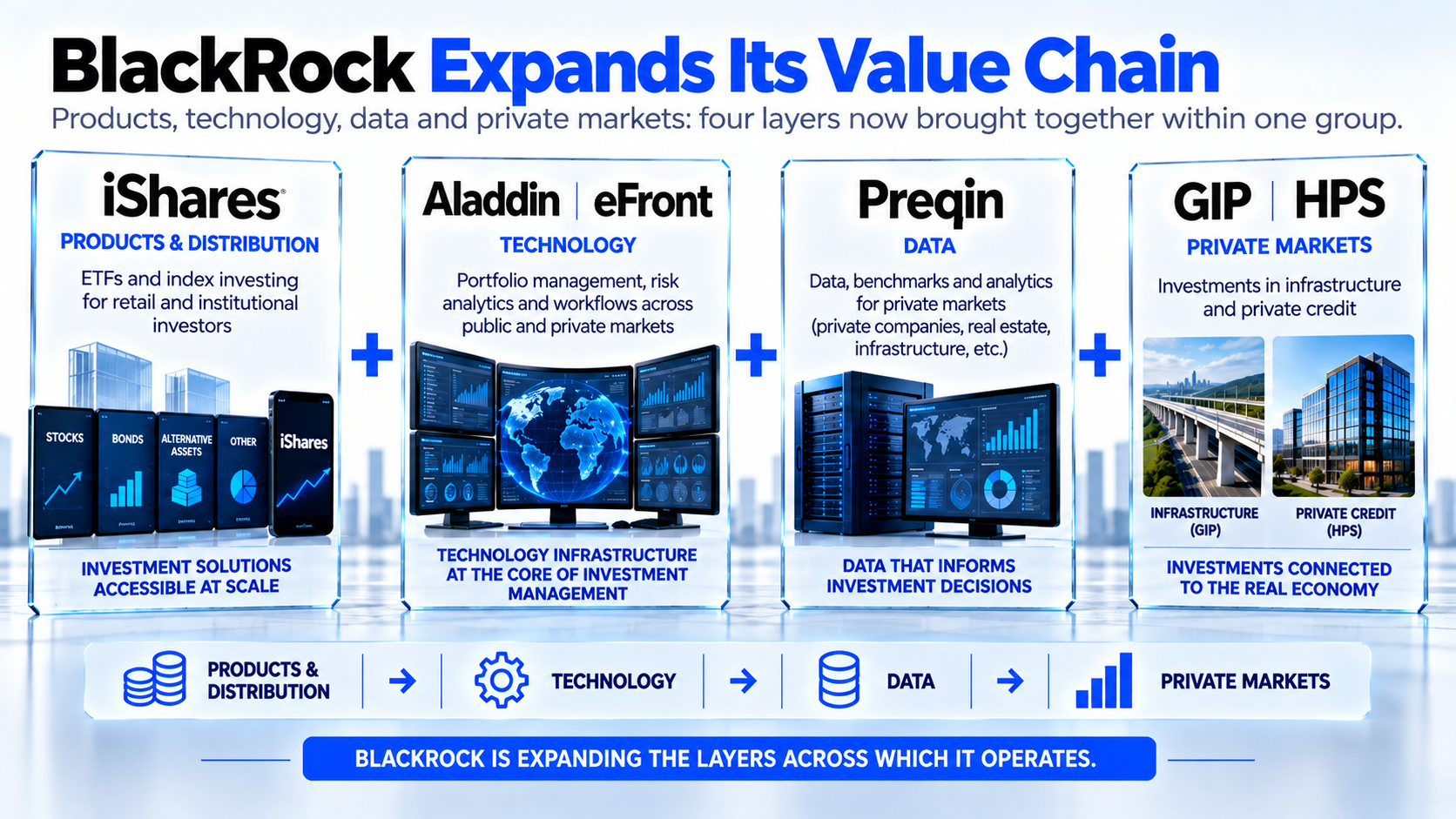
Together, however, they form a coherent architecture:
- iShares → products and distribution
- Aladdin + eFront → technology
- Preqin → data
- GIP + HPS → private markets
BlackRock is seeking to connect several steps that were once more separate: investing in, administering, analyzing and measuring portfolios that combine public and private assets.
Why private markets are becoming essential
This shift also responds to a limitation of the historical model.
In public markets, many products are standardized, liquid and subject to intense fee pressure.
Private markets are different.
Infrastructure, private credit, real estate and private equity require more selectivity, more data and more expertise.
And they can generate higher fees relative to the capital managed.
At the end of 2025, BlackRock managed approximately $323 billion in private markets.
It also had about $91 billion of client commitments that were not yet invested and not yet earning fees.
Its stated ambition: to raise $400 billion in private markets by 2030.
But the strategy goes beyond how much capital BlackRock can raise.
An institutional investor may simultaneously hold listed equities, bonds, infrastructure, private credit and other unlisted assets.
The more these worlds overlap, the more valuable a unified view of the portfolio becomes.
That is precisely where the strategy comes together:
investments through GIP and HPS, technology through Aladdin and eFront, and data through Preqin.
BlackRock is no longer seeking only to grow its assets under management.
It wants to be present in more of the layers required to manage them.
A central position is not an invulnerable one
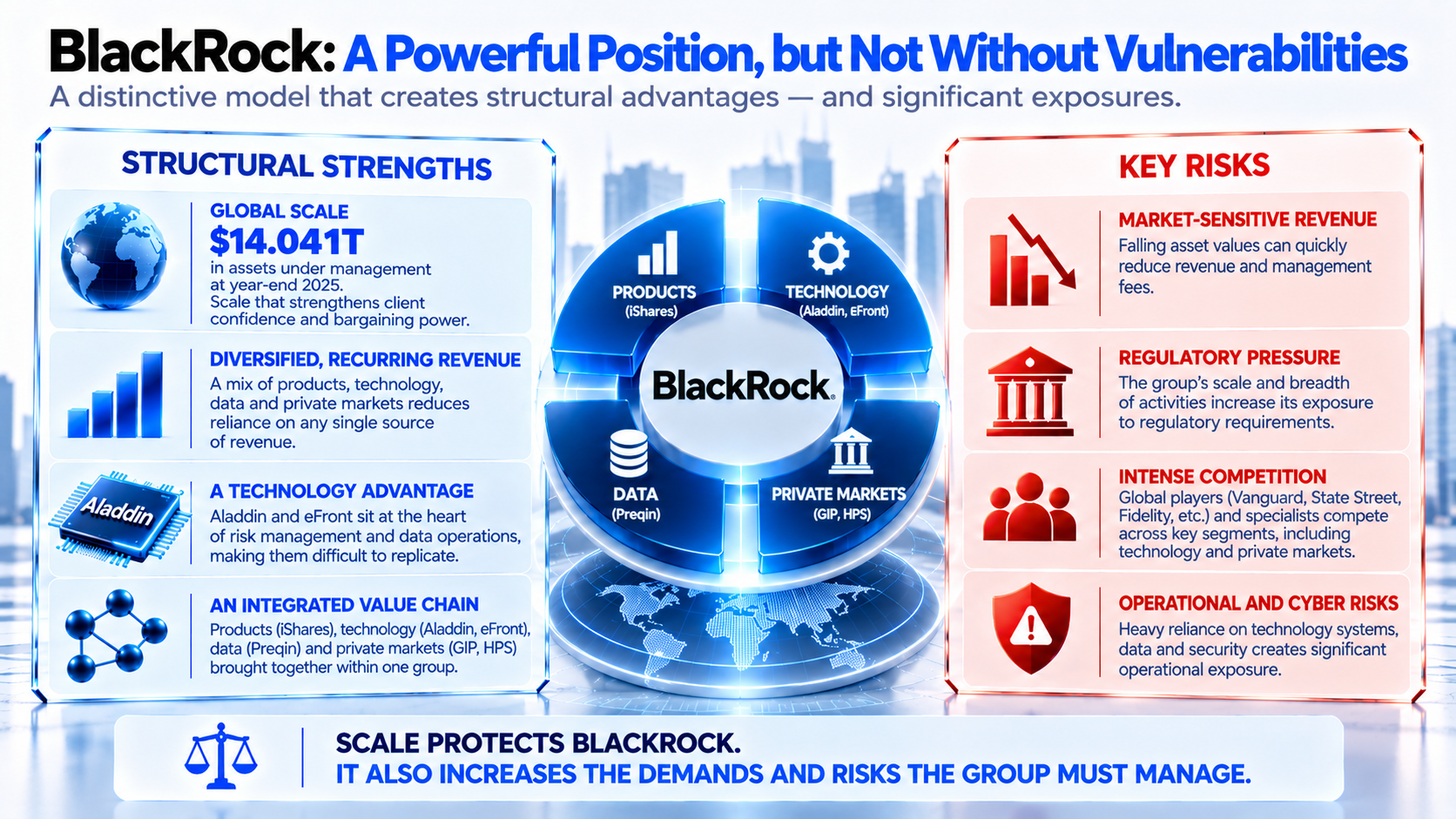
This architecture gives BlackRock a powerful position.
But it does not turn the firm into a self-contained system.
Much of its business remains directly exposed to financial markets.
When markets rise, the value of the assets it manages can increase and support fees.
When they fall, the mechanism can work in reverse.
Competition is a second constraint.
In index products, it keeps fees under heavy pressure.
In private markets, the economic potential is greater, but investments are generally less liquid and more complex to manage.
Finally, BlackRock has just absorbed several major businesses.
GIP.
Preqin.
HPS.
Bringing them under one roof does not automatically mean that their technologies, data, teams and client relationships will form a seamlessly integrated platform.
BlackRock itself presents their combination as one of its main strategic priorities for the years ahead.
Its 2030 targets include generating 30% or more of its revenue from private markets and technology.
It is a measurable ambition.
Not yet a guaranteed outcome.
BlackRock’s real product now extends beyond its funds
The $14 trillion figure draws all the attention.
But it no longer tells the whole story.
BlackRock first built its scale in asset management.
iShares amplified that scale through ETFs and index investing.
Aladdin turned an in-house technology into infrastructure sold to other institutions.
GIP and HPS now extend the firm into private markets.
Preqin adds data.
What emerges, then, is not a company that “owns global finance.”
It is something more precise.
A firm present at several of the points where money is invested, administered, analyzed and measured.
And that may be BlackRock’s most interesting paradox:
its power does not come from owning $14 trillion.
It comes from the position the firm has gradually built around managing it.
Key takeaways
- BlackRock managed $14.041 trillion at the end of 2025, but it manages those assets on behalf of its clients: they are not the firm’s own wealth.
- The 2009 acquisition of BGI, and with it iShares, gave BlackRock considerable scale in index investing.
- Aladdin adds a technology business to asset management; technology services and subscription revenue reached approximately $2 billion in 2025.
- With GIP, HPS and Preqin, BlackRock now aims to combine public markets, private markets, technology and data.
Sources
Financial and operating data come from BlackRock’s regulatory filings and annual reports; information on acquisitions comes from the company’s official press releases.
- BlackRock — 2025 Form 10-K. sec.gov. Assets under management at year-end 2025, fees, breakdown of assets and revenue, technology services and subscriptions, private markets, and the GIP, Preqin and HPS acquisitions.
- BlackRock — 2025 Annual Report. sec.gov. 2025 annual report: the firm’s business activity and strategic direction.
- BlackRock — 2009 Annual Report. ir.blackrock.com. Merger with Barclays Global Investors, assets under management and the weight of index investing after the deal.
- BlackRock — Acquisition of Preqin. ir.blackrock.com. Completion of the Preqin acquisition and planned integration of its data with Aladdin and eFront.
- BlackRock — Acquisition of HPS Investment Partners. ir.blackrock.com. Completion of the HPS Investment Partners acquisition in July 2025 and expansion in private credit.