
A card payment feels almost instantaneous. A shopper taps a card or a phone, the terminal responds a few seconds later, and the purchase is approved or declined.
Behind that simple gesture sits a far more complex system. The merchant, the merchant’s bank, the payment network and the bank that issued the card all have to exchange the information the transaction needs, in a matter of seconds.
Visa sits in the middle of that chain. It is generally neither the cardholder’s bank nor the lender whose money pays for the purchase. What it provides is a common network that lets thousands of institutions on both sides of a payment talk to each other at enormous scale.
That position, more than any single product, is what has made Visa one of the least visible and most essential pieces of infrastructure in global commerce.
Visa does not lend the money behind the payment
A common misconception is that Visa is a bank. Its role is different.
When a consumer pays with a Visa card or another Visa-branded payment product, the money generally comes from an account or a line of credit provided by a financial institution, the issuer. On the merchant’s side, a second institution, the acquirer, routes the transaction from the point of sale.
The Visa network sits between them. It carries and processes the information needed to authorize, clear and settle the payment.
The issuer normally decides whether to approve or decline a transaction, applying its own rules and risk checks. In certain circumstances, Visa’s stand-in processing can make an authorization decision on the issuer’s behalf when the issuer is unavailable or unable to respond. This does not make Visa the lender behind the purchase.
Visa therefore does not need to finance a purchase to play a central role in completing it. Its job is to make sure several independent institutions can work together.
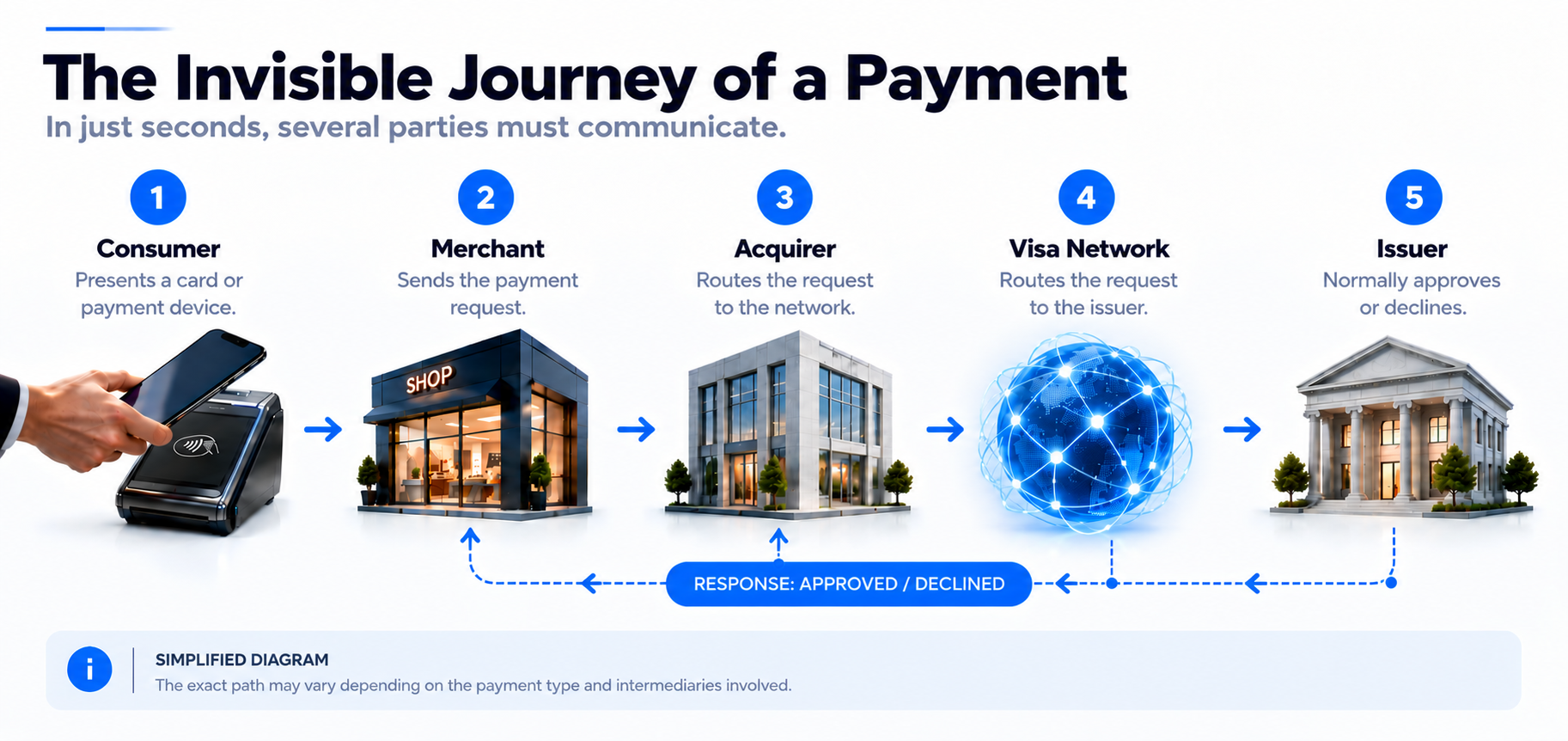
A network operating at enormous scale
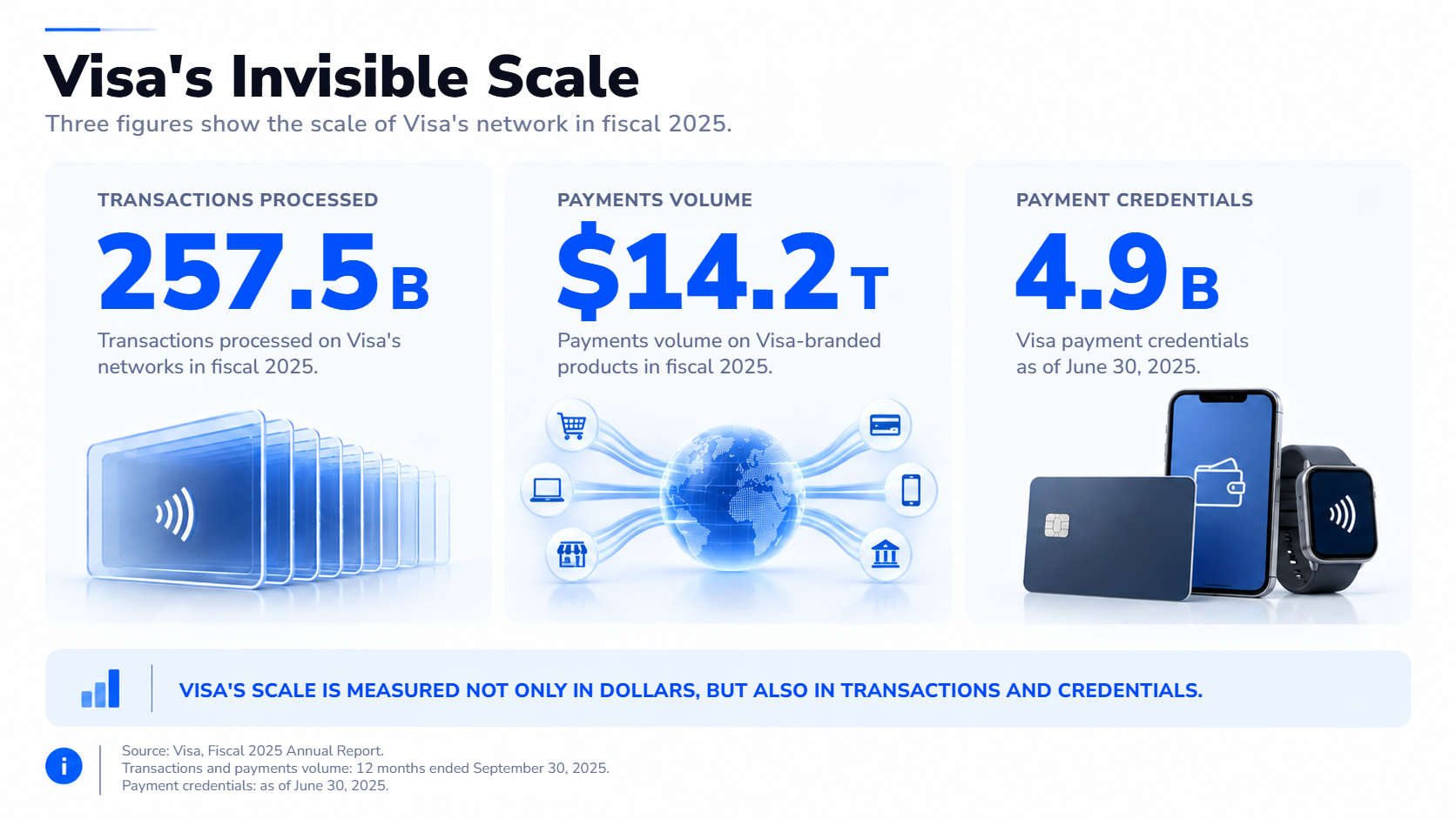
The value of a payment system depends in large part on its ability to operate at very large scale, and Visa’s figures are measured in the billions and trillions.
In fiscal 2025, Visa processed 257.5 billion transactions on its networks. According to its annual report, payments volume on Visa-branded cards and other payment products reached about $14.2 trillion in the fiscal year ended September 30, 2025. Visa also reported 4.9 billion payment credentials as of June 30, 2025.
These three figures measure different things. Processed transactions count activity on the network. Payments volume measures the dollar value of purchases made with Visa-branded products. Visa’s reported payment credentials measure the issued card accounts associated with its payment products, which can be used through physical cards or other payment form factors.
Taken together, they show the reach of an infrastructure that most people use without ever seeing it.
Why a shared network is so valuable
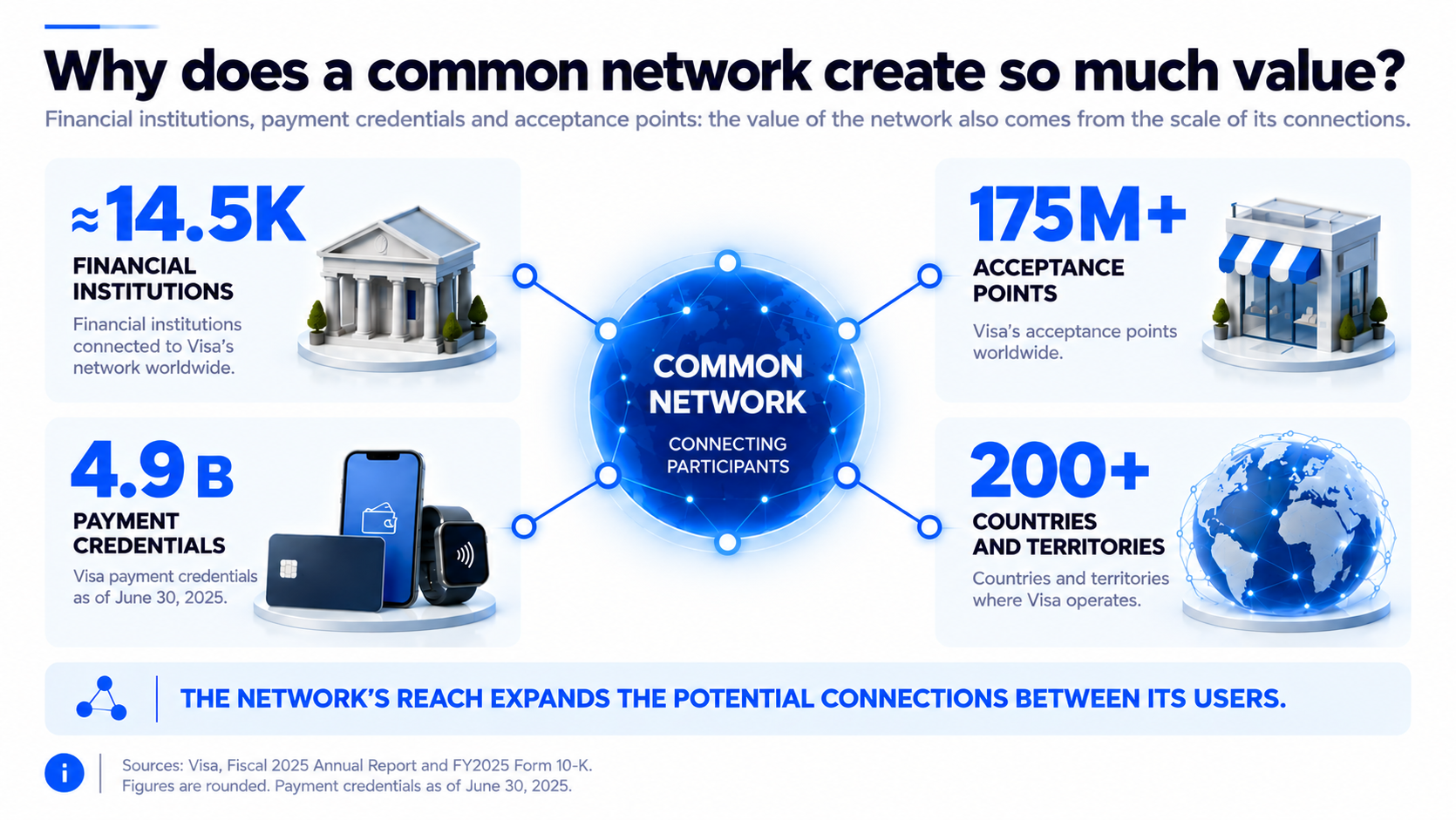
Scale is not only a matter of transaction counts. Visa says it works with nearly 14,500 financial institutions, operates in more than 200 countries and territories and counts more than 175 million merchant locations worldwide.
That reach gives Visa’s system its essential property: a very large number of institutions and businesses can rely on the same infrastructure. A bank issuing cards does not need to build a dedicated connection to every merchant that might accept them. A merchant, in turn, can accept cards from thousands of issuers without setting up a separate technical relationship with each one.
The network acts as a common layer. As more issuers, merchants and payment credentials join the system, the potential for interactions across the network expands.
This is why the scale of a payment network can become an advantage that is hard to replicate quickly. Building technology that can carry a transaction is only part of the challenge. Bringing enough banks, merchants and cardholders onto the same rails is far harder.
Visa does not keep the money that flows through the system
Headline volumes can give a misleading picture of Visa’s business model.
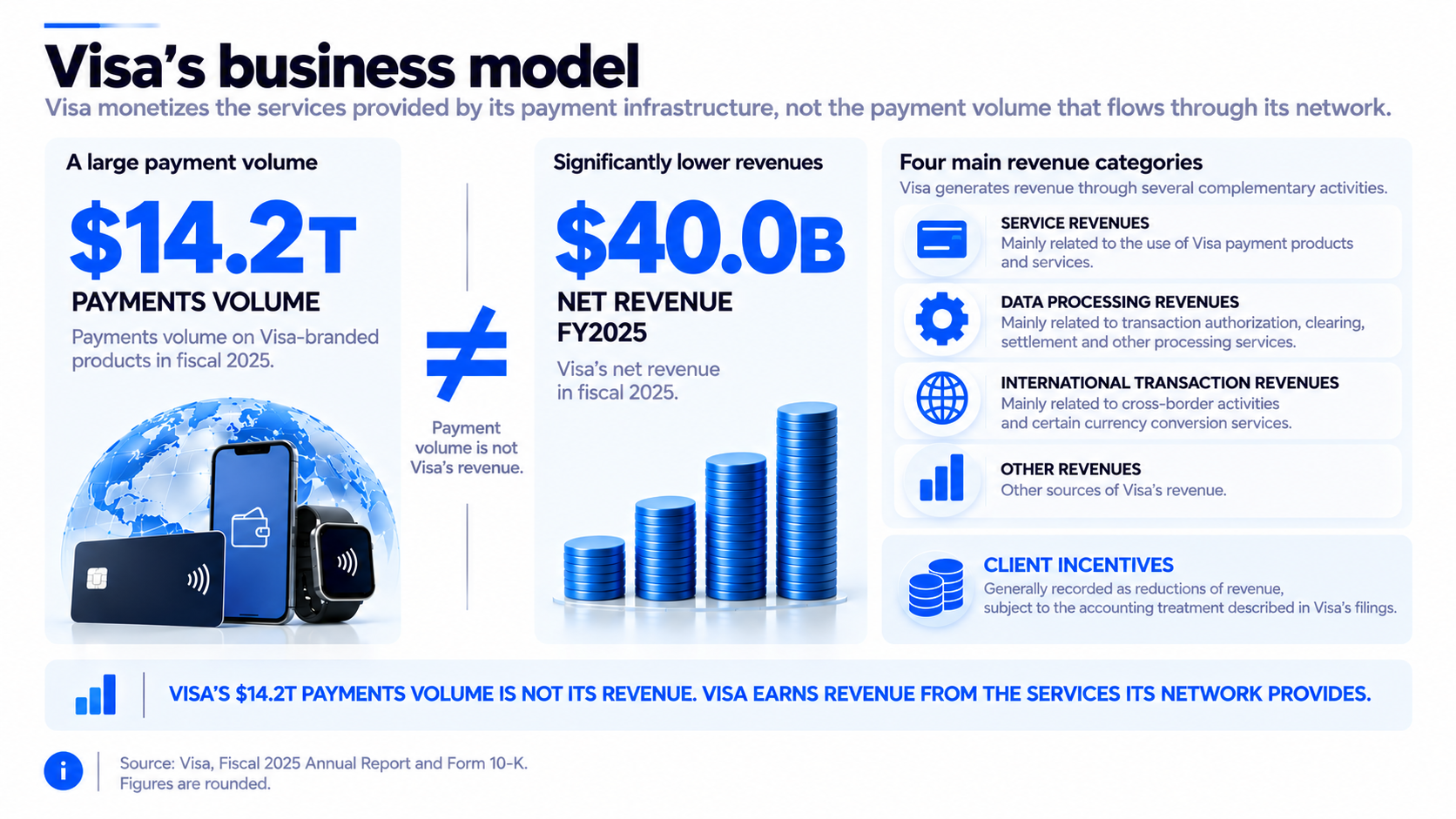
In fiscal 2025, payments volume on Visa-branded products reached about $14.2 trillion. That is not Visa’s revenue. The company’s net revenue for the year was $40.0 billion.
The difference is fundamental. Visa does not keep the value of the payments that move through its ecosystem; it earns money from the services its network provides.
Visa reports its revenue in four main categories:
- Service revenue, earned for services that support clients’ use of Visa payment services.
- Data processing revenue, earned mainly for authorization, clearing and settlement, network access and related processing services.
- International transaction revenue, earned for cross-border transaction processing and currency conversion activities.
- Other revenue, including value-added services and fees such as licensing.
One more element shapes the bottom line: client incentives. These are payments and other incentives that Visa provides to financial institutions, merchants and other partners to grow payments volume and encourage the use and acceptance of its products. In fiscal 2025, Visa recorded about $15.8 billion in client incentives as reductions of revenue in arriving at reported net revenue; Visa’s filings describe the accounting treatment in more detail.
The business model therefore cannot be reduced to a single percentage taken evenly from every payment.
A system that must always be available
Operating at this scale also brings a demanding requirement: payments have to work whenever consumers and merchants need them.
The system must handle a very large number of requests at once, connect different institutions and pass on the necessary information quickly enough for the whole process to feel instantaneous.
For the shopper, the interaction lasts a few seconds. Behind it, the transaction moves through several separate systems. That gap between the apparent simplicity of a payment and the complexity underneath is a large part of what Visa provides.
The more deeply Visa is woven into everyday life, the less visible it becomes to the people who use it.
Why this position is hard to replicate
Building a payment technology is one thing. Building a network used by thousands of financial institutions, billions of payment credentials and more than 175 million merchant locations is another.
The real difficulty is coordination. A payment network is only useful if every side of the transaction can use it: the institutions that issue cards and accounts, those that serve merchants, the processing systems in between and a vast number of points of acceptance.
That footprint cannot be built with software alone. It rests on commercial relationships, technical standards, operational systems and an international presence developed over a long period.
That is what gradually turns a payment network into infrastructure. Its value no longer comes only from the technology it uses, but from the number of institutions and businesses already able to operate through it.
Key takeaways
- Visa is generally not the bank that lends the money a consumer uses to pay, and the issuer normally approves or declines the transaction.
- Visa’s network lets issuers, acquirers and merchants exchange the information needed to authorize, clear and settle a payment.
- In fiscal 2025, Visa processed 257.5 billion transactions, and payments volume reached about $14.2 trillion in the fiscal year ended September 30, 2025.
- Visa works with nearly 14,500 financial institutions, operates in more than 200 countries and territories, and counts more than 175 million merchant locations.
- Payments volume is not revenue: Visa generated $40.0 billion in net revenue in fiscal 2025, after about $15.8 billion in client incentives.
Visa became central to global payments without being the consumer’s bank or the merchant that receives the money. Its position comes from the network that sits between them.
Every transaction requires several institutions to communicate quickly through a common system. Multiplied across hundreds of billions of transactions, thousands of financial institutions and millions of merchant locations, that function becomes very hard to replace.
That is the paradox at the heart of Visa: it is barely visible to the people who use it, yet deeply embedded in the way the world pays.
Sources
This analysis is based on Visa’s own financial and regulatory filings for fiscal 2025, which ended September 30, 2025: its annual report and its Form 10-K filed with the U.S. Securities and Exchange Commission. Measurement dates differ by indicator and are noted below.
- Visa Inc. — Fiscal 2025 Annual Report. s29.q4cdn.com — Fiscal year 2025 key statistics (also published at annualreport.visa.com): processed transactions (257.5 billion) and payments volume ($14.2 trillion) for the 12 months ended September 30, 2025; payment credentials (4.9 billion) as of June 30, 2025; net revenue ($40.0 billion).
- Visa Inc. — Annual Report on Form 10-K for the fiscal year ended September 30, 2025, U.S. Securities and Exchange Commission. sec.gov — Processed transactions (257,545 million), net revenue ($40,000 million), revenue categories and client incentives ($15,751 million); nearly 14,500 financial institutions, more than 175 million merchant locations and more than 200 countries and territories; description of stand-in processing.