For years, the race to lead artificial intelligence was defined mainly by algorithms, increasingly powerful models, and the chips needed to run them.
But as AI systems grow more demanding, another factor is becoming just as important: the physical infrastructure required to run them at scale.
Training and running advanced models requires thousands of processors, interconnected servers, sophisticated cooling systems, specialized buildings, and enormous amounts of electricity.
A data center is no longer simply a building filled with servers. It is becoming critical infrastructure on which AI depends.
And in an industry where computing capacity determines how quickly new systems can be trained and deployed, the ability to build, power, and connect these facilities has become a strategic priority.
AI is triggering a new wave of investment
The scale of this shift shows first in the capital flowing into data center infrastructure.
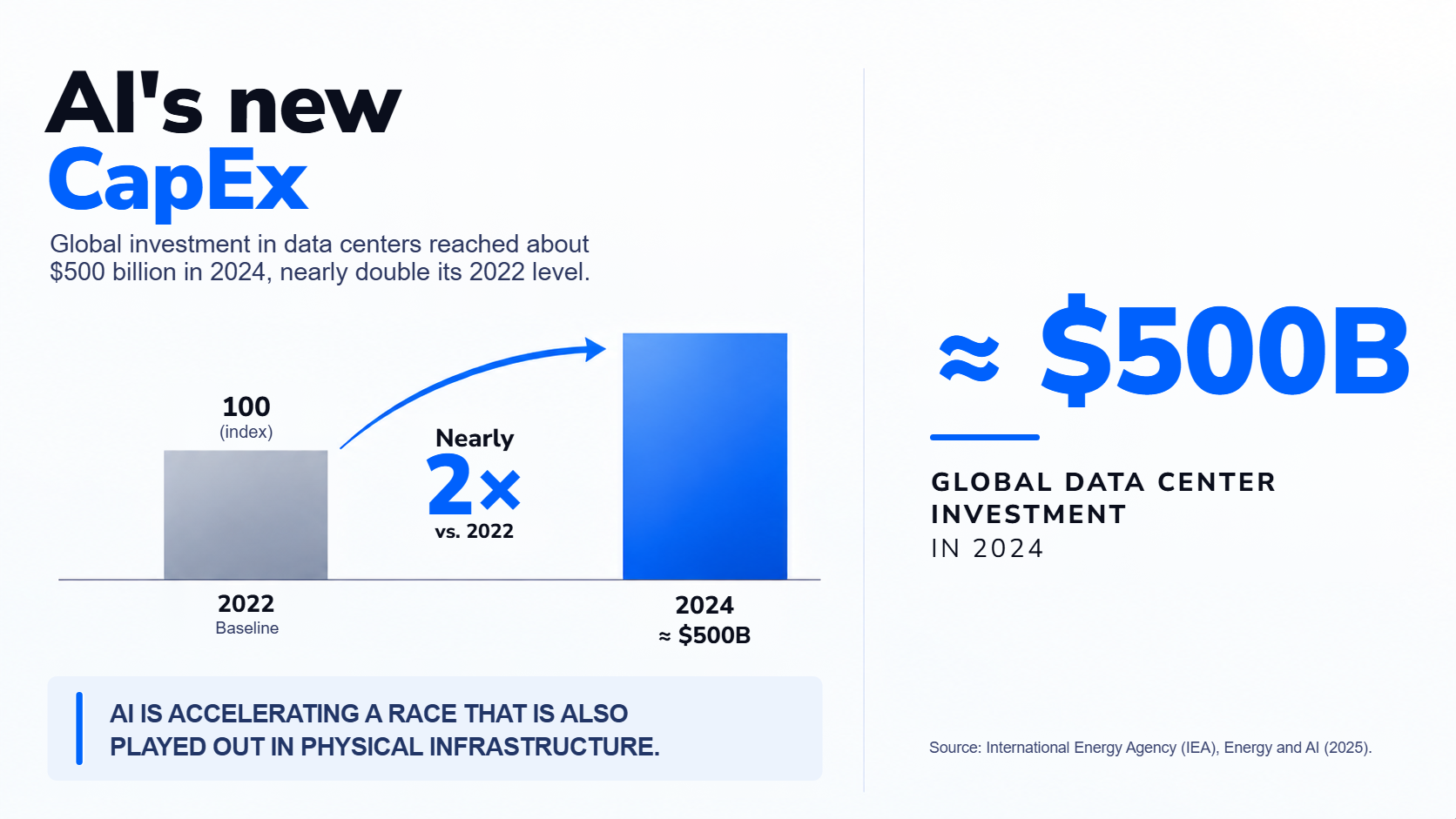
According to the International Energy Agency (IEA), global investment in data centers reached about $500 billion in 2024, nearly twice its 2022 level.
That spending goes far beyond buildings.
AI-ready facilities also require computing hardware, electrical systems, cooling equipment, high-speed networking and, in some cases, new energy infrastructure. Each of these adds cost, complexity, and potential delays.
The race for artificial intelligence is therefore also a race to deploy physical capital.
Announcing an investment is only the beginning: the money still has to become infrastructure that is built, connected, and brought online.
Electricity demand is changing scale
This expansion has a direct consequence: data centers need more and more electricity.
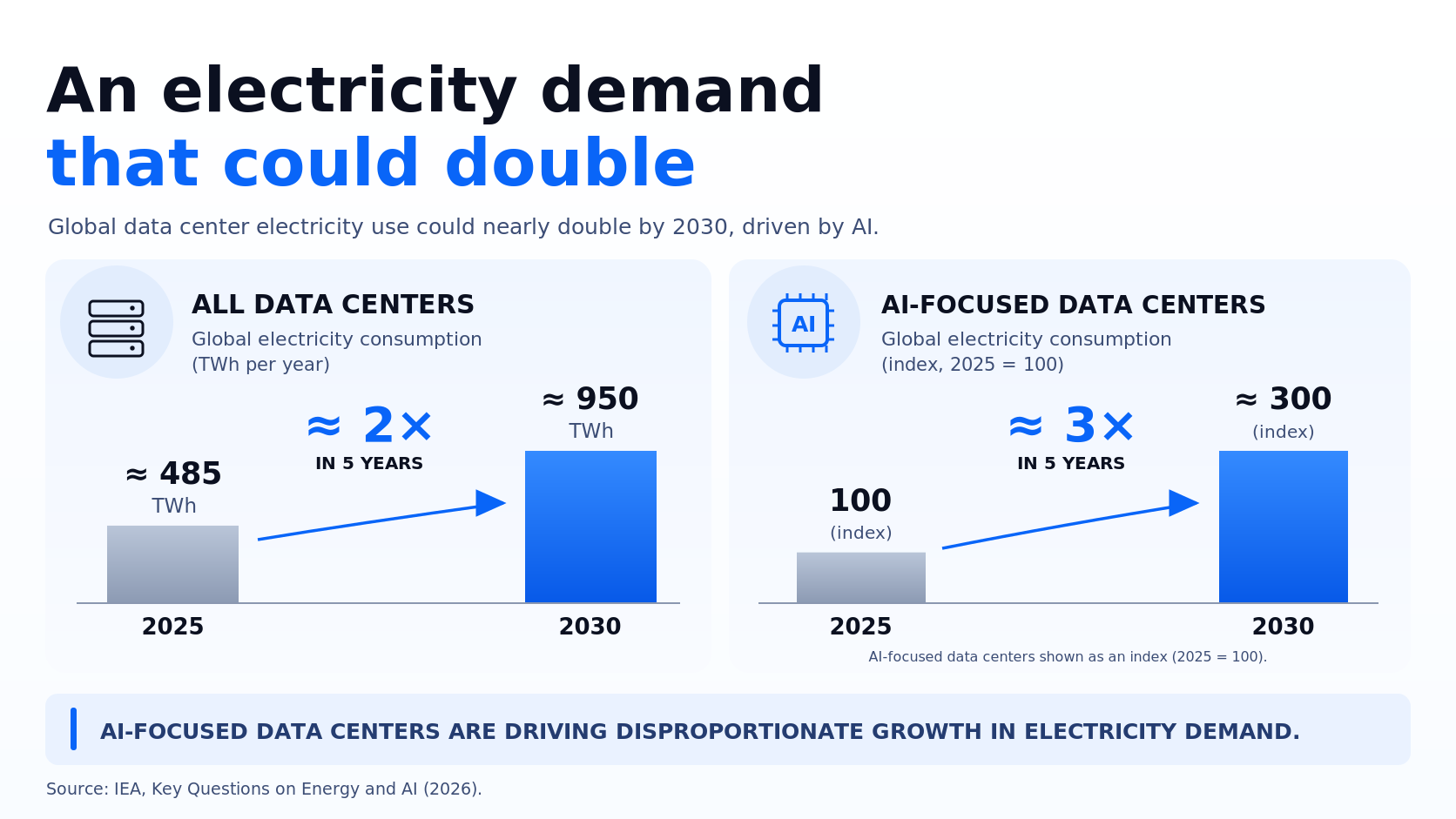
According to the IEA’s April 2026 update, global data center electricity consumption could rise from about 485 terawatt-hours (TWh) in 2025 to about 950 TWh in 2030, almost doubling in five years.
Consumption by AI-focused data centers is expected to grow even faster, roughly tripling over the same period.
AI is therefore not just adding demand to existing infrastructure. It is changing the energy scale of the industry itself.
As computing clusters grow larger and more power-intensive, electricity availability increasingly shapes where new facilities can be built and how quickly they can start operating.
A site may offer suitable land, good construction conditions, and access to telecommunications networks. Without enough power and a viable grid connection, however, those advantages do not translate into usable computing capacity.
Building a data center is not enough
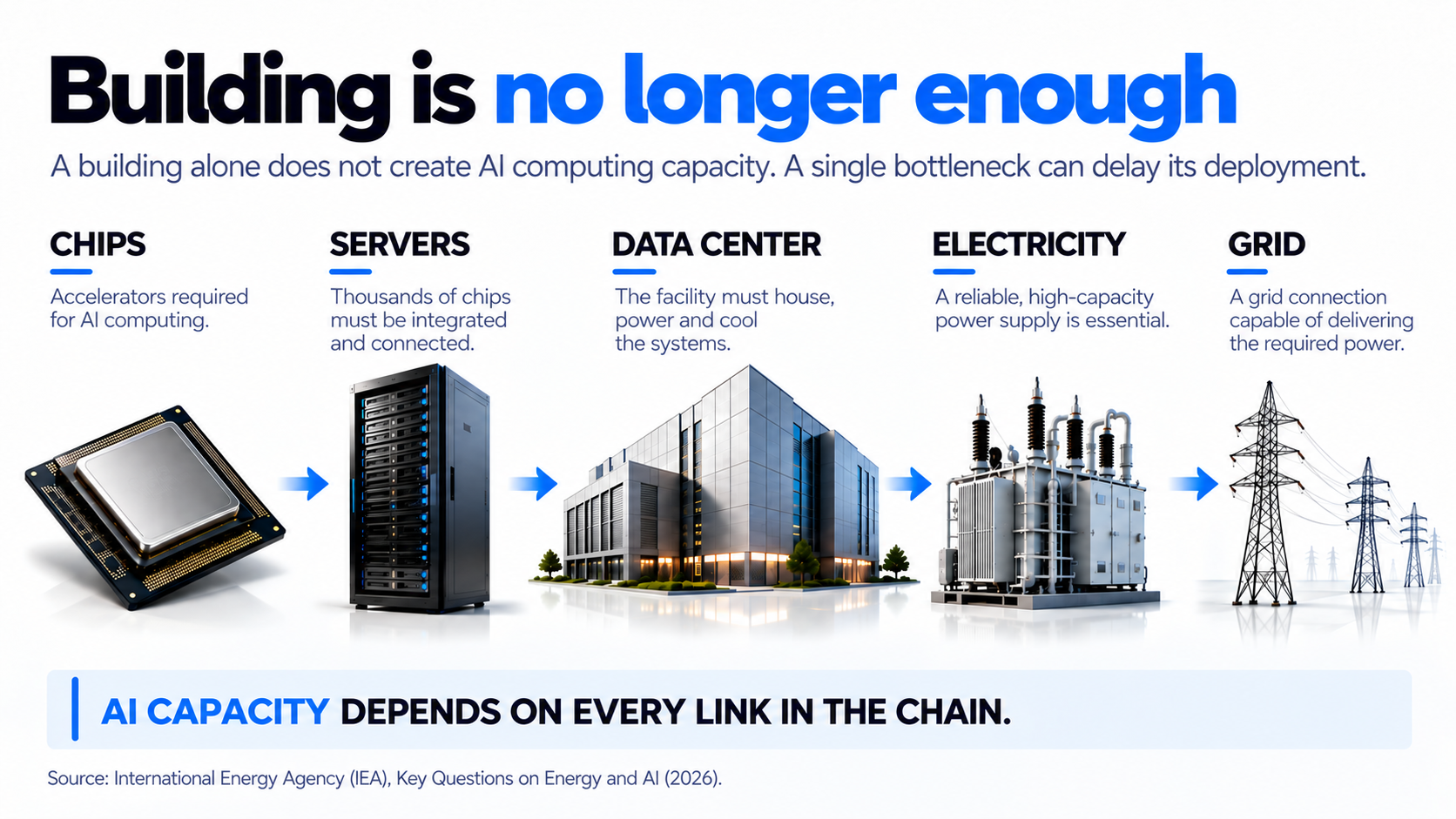
A completed building does not automatically create usable AI computing capacity.
Before a new AI cluster can operate, several links in a chain must be in place at the same time.
Operators first need the accelerators that run AI workloads.
These chips must then be integrated into servers, networked together, and configured to work as a single system.
Those systems need a facility that can power them and remove the heat they generate.
Finally, the site needs an electricity supply and a grid connection large enough for its planned load.
Each link depends on the others. A shortage of accelerators delays server deployment. Insufficient cooling limits how much hardware can be installed. Inadequate grid capacity can keep a finished facility from running at its planned scale.
A company can therefore have the financing for a new data center without being able to bring the corresponding computing capacity online right away.
What ultimately counts is not infrastructure under development, but computing capacity that is actually available for use.
The infrastructure race is now measured in gigawatts
The size of recent announcements shows how much AI infrastructure requirements have changed.
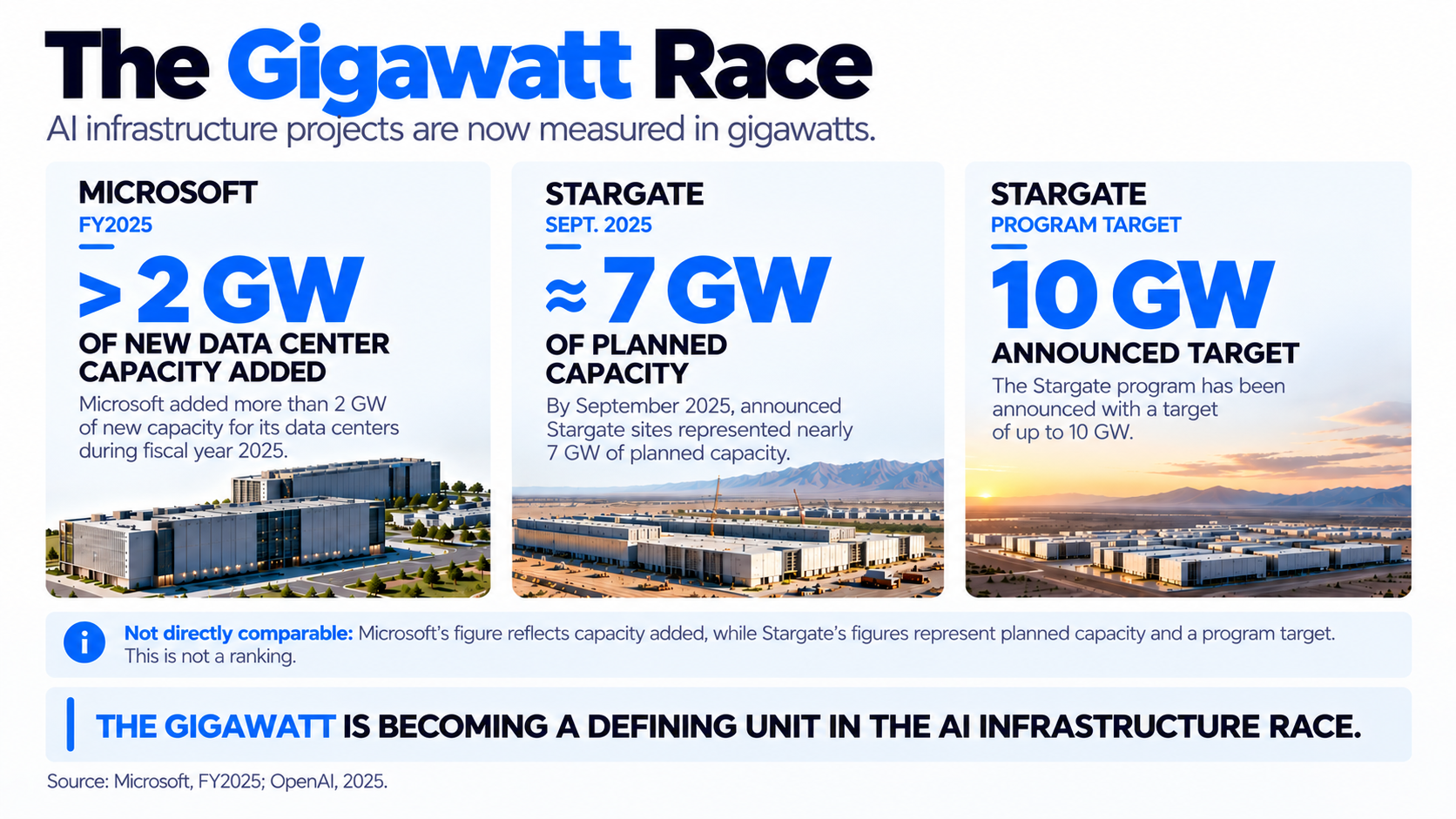
Reporting results for its 2025 fiscal year in July 2025, Microsoft said it had stood up more than 2 gigawatts (GW) of new data center capacity over the previous 12 months.
In September 2025, OpenAI said its newly announced Stargate sites, together with its flagship site in Abilene, Texas, and ongoing projects with CoreWeave, brought the program to nearly 7 GW of planned capacity.
OpenAI describes Stargate as a $500 billion, 10 GW commitment, which it says it announced in January 2025.
These numbers measure different things. Microsoft’s figure is new capacity added over a 12-month period. Stargate’s 7 GW is planned capacity tied to announced sites, and its 10 GW is a stated program target. These figures are not measures of the companies’ total operational data center capacity.
They should not be read as a ranking of companies.
They do, however, reveal a shift. The gigawatt, a unit long associated with power plants and electricity grids, now routinely appears in announcements about AI data centers.
The future of AI is becoming tied to the ability to secure energy and computing infrastructure on a very large scale.
Why data centers are becoming strategic assets
An AI model’s performance depends on its architecture, its training, and the processors that run its computations.
But even the most advanced hardware has little operational value if it cannot be deployed at scale.
Data centers are where individual components become usable systems. They combine processors, servers, networking, cooling, and power into computing power that can actually be used.
That does not make every data center operator strategically indispensable. Every large AI developer depends on physical infrastructure, and dependence alone is not a competitive advantage.
The advantage comes from securing scarce resources, such as sites, equipment, power, and timely grid connections, and from bringing new capacity online faster or more reliably than competitors.
As demand grows, competition is no longer limited to building better models or obtaining advanced chips. It also involves securing the infrastructure needed to put them to work.
Data centers have become the meeting point of the semiconductor industry, cloud computing, electricity networks, and artificial intelligence.
A constraint that could reshape the geography of AI
Not every region has the same electricity supply, grid capacity, construction conditions, or connection timelines.
These differences can influence where future AI computing capacity is built.
A location close to major technology markets may look commercially attractive. But if its grid cannot absorb new demand within a reasonable timeframe, projects may be delayed.
Conversely, regions that can provide enough power, reliable connectivity, and suitable infrastructure may attract new projects.
Electricity is not the only factor. Network latency, data governance rules, operating costs, access to equipment, and proximity to customers also matter.
But energy and infrastructure constraints carry growing weight in these decisions. Demand for computing power does not guarantee that facilities can be built and powered where that demand originates.
The geography of AI may therefore increasingly reflect where physical infrastructure is available, not only where AI companies are concentrated.
The race to develop artificial intelligence is no longer fought only through algorithms, software, and semiconductors.
It is also playing out on construction sites, across electricity networks, and in facilities built to deliver computing power at unprecedented scale.
Building more advanced AI will require more than access to powerful chips. It will require the ability to turn investment, equipment, and energy into operational computing capacity.
Data centers are becoming one of the physical battlegrounds on which the next phase of AI will be built.
Key takeaways
- Global investment in data centers reached about $500 billion in 2024, nearly double its 2022 level, according to the IEA.
- The IEA projects global data center electricity consumption to rise from about 485 TWh in 2025 to about 950 TWh in 2030.
- Consumption by AI-focused data centers is expected to roughly triple over the same period.
- Deploying AI computing capacity requires chips, servers, a facility that can power and cool them, electricity, and a grid connection, all at the same time.
- Gigawatt-scale announcements show AI’s growing physical footprint, but capacity added, planned capacity, and program targets are not directly comparable.
Sources
Figures come from the International Energy Agency’s 2025 and 2026 reports on energy and AI and from official Microsoft and OpenAI communications.
- International Energy Agency — Energy and AI (April 2025). iea.org — Global data center investment of about $500 billion in 2024, nearly double its 2022 level.
- International Energy Agency — Key Questions on Energy and AI (April 2026). iea.org — Data center electricity consumption of about 485 TWh in 2025 and about 950 TWh in 2030; AI-focused data centers roughly tripling over the period.
- Microsoft — FY2025 Fourth Quarter Earnings Conference Call (July 30, 2025). microsoft.com — More than 2 GW of new data center capacity stood up over the previous 12 months, reported with fiscal year 2025 results.
- OpenAI — OpenAI, Oracle, and SoftBank expand Stargate with five new AI data center sites (September 23, 2025). openai.com — Nearly 7 GW of planned capacity and the $500 billion, 10 GW commitment that OpenAI says it announced in January 2025.