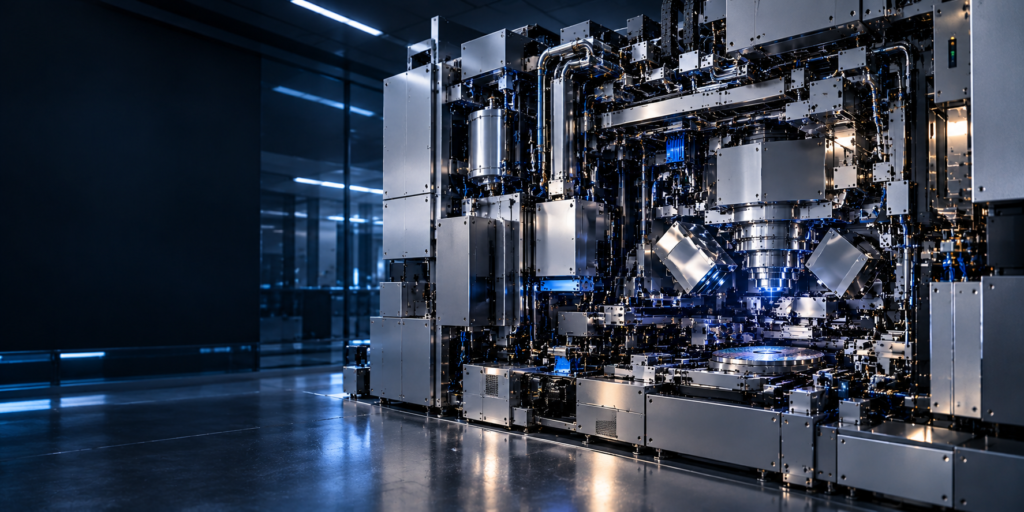
A company almost nobody sees
Open up a smartphone. Chances are its processor is built on Arm technology.
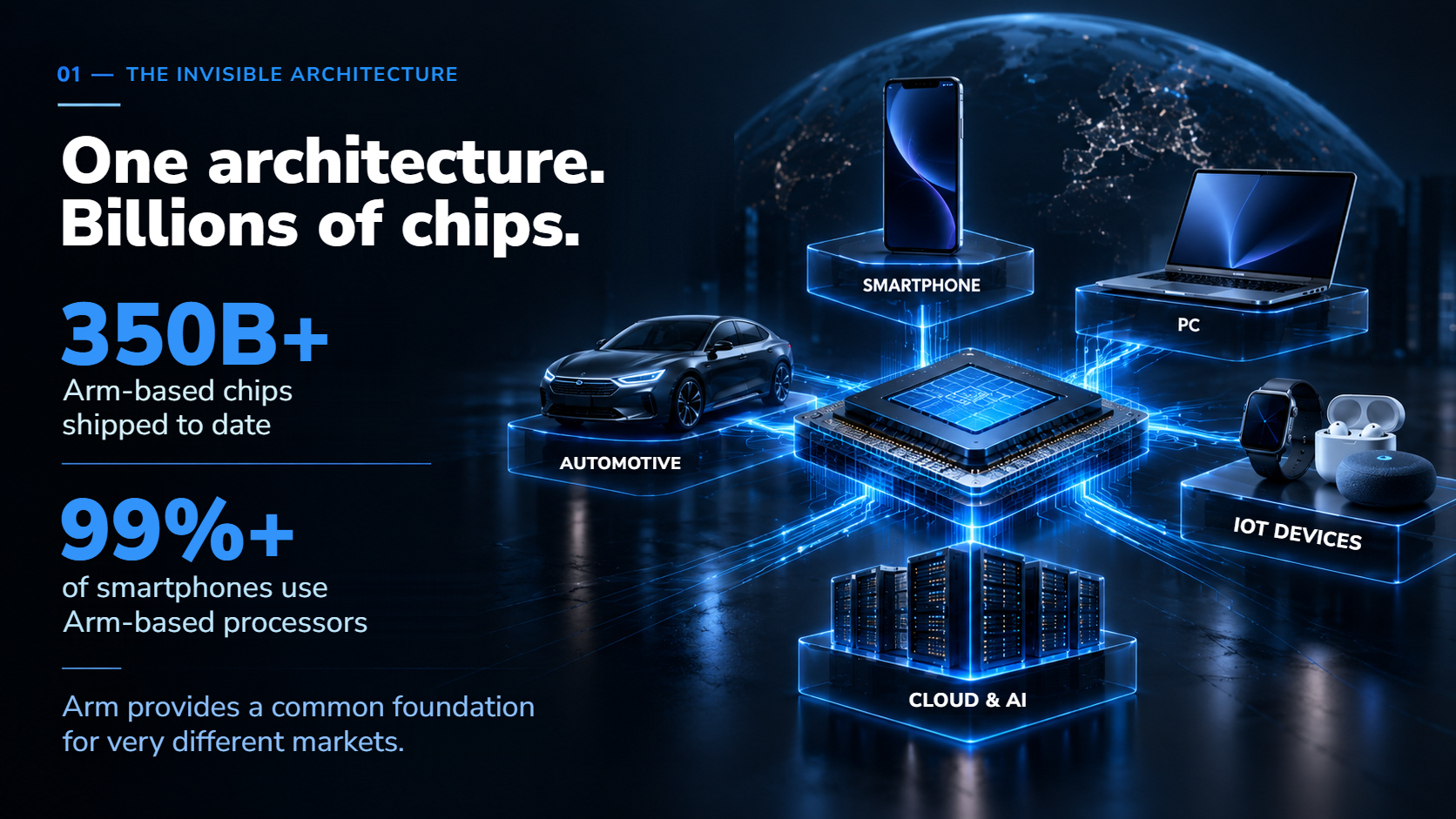
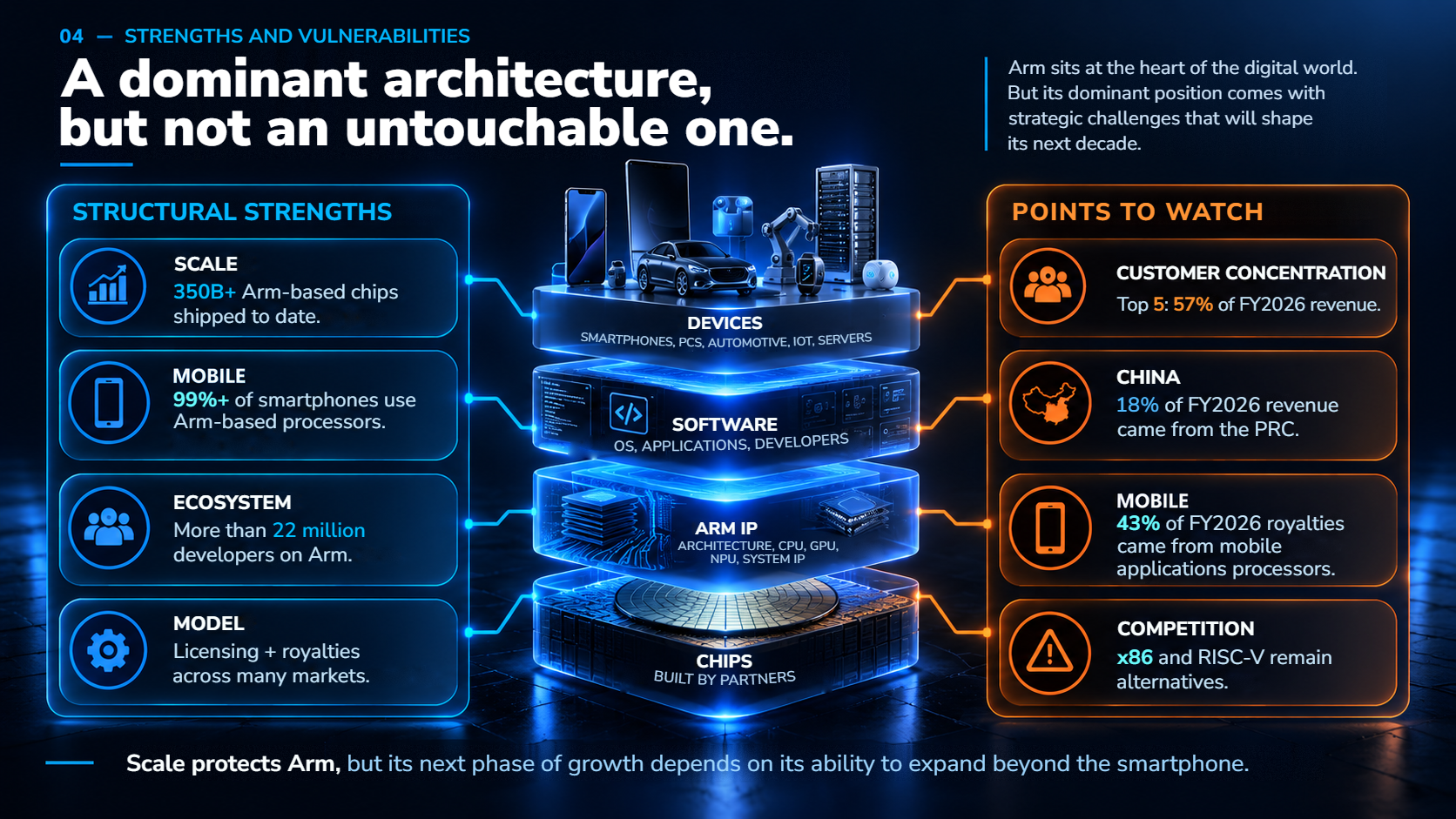
Not just certain models: Arm says processors based on its architecture power more than 99% of smartphones. More broadly, more than 350 billion Arm-based chips have been shipped since the company was founded.
Yet Arm does not operate like a traditional semiconductor manufacturer.
It does not own the giant factories that produce these billions of components. And, historically, it did not even sell the finished processors you find inside your devices.
It sells something more fundamental: the blueprints that allow other companies to design their own chips.
It is this position, almost invisible to consumers, that explains how a company born in Cambridge became one of the foundations of the digital world.
It all starts with a constraint: the battery
The story goes back to the 1980s.
At Acorn Computers, Sophie Wilson and Steve Furber were working on a processor built on a RISC philosophy: using a relatively simple instruction set to deliver high computing performance with an efficient design.
The first ARM1 silicon arrived in 1985. Then, in 1990, Advanced RISC Machines became an independent company, set up as a joint venture between Acorn Computers, Apple Computer and VLSI Technology.
This pursuit of efficiency became particularly relevant with the rise of battery-powered devices.
Arm processors began to gain ground in mobile phones in the mid-1990s because they offered a particularly attractive trade-off: enough performance with limited power consumption.
As phones turned into miniature computers, this characteristic became strategic.
But it explains only part of the story.
Arm never wanted to make every chip itself
The real change of scale came from the business model.
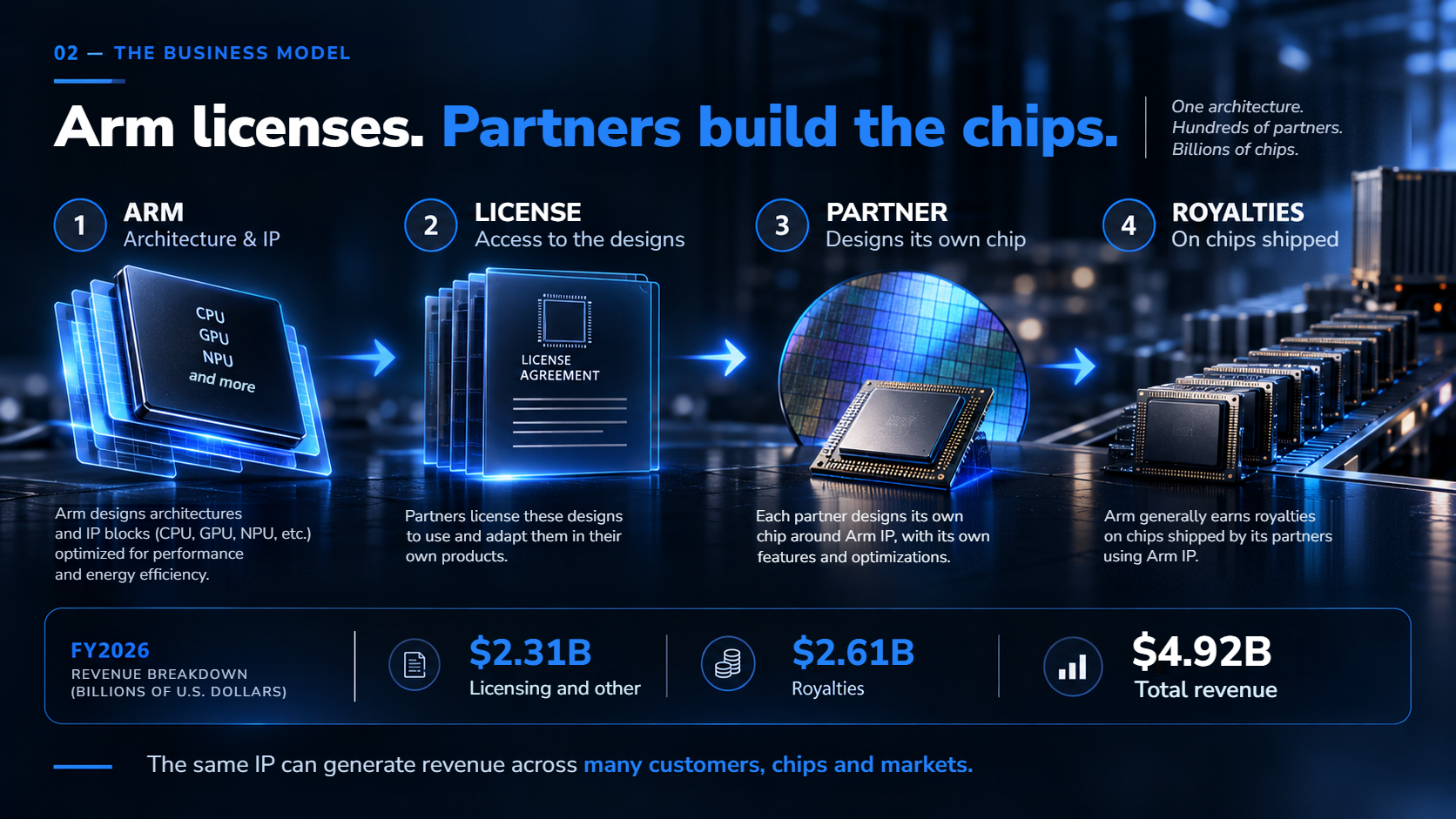
Rather than designing a single chip, manufacturing it and then trying to sell it to every device maker, Arm develops architectures and intellectual property that other companies can license and integrate into their own processors.
A partner pays for access to Arm technology. It then develops its own system-on-chip, possibly combining Arm technologies with its own components. When the resulting chips ship, Arm generally collects a royalty per unit.
The result is powerful.
Two companies can use the same technological foundation while producing very different processors.
Arm therefore does not need to pick a single winner.
Its technology can be used simultaneously by many designers, across many chip families and in many markets.
Licensing turns Arm into a multiplier
This model completely changes the company’s economics.
In fiscal year 2026, Arm generated $4.92 billion in revenue.
Of that total:
- $2.31 billion came from licensing and other revenue
- $2.61 billion came from royalties
This distinction is essential.
The license pays for access to the technology.
The royalty then lets Arm share economically in the success of the chips that use that technology.
An architecture developed once can thus be used by several partners, reused across several product generations and generate revenue over a long period.
It is an unusual form of industrial leverage: Arm can reach an immense amount of silicon without having to manufacture each chip itself.
Then the smartphone creates a de facto standard
The more widely Arm processors are adopted, the more another force comes into play: the ecosystem.
Operating systems, compilers, libraries, development tools and applications are gradually optimized around this architecture.
Developers therefore have an incentive to support Arm because users are already there.
Device makers have an incentive to use Arm because the software ecosystem already exists.
Today, Arm reports more than 22 million developers working on its platform.
It is a loop that is particularly hard to replicate.
Arm does not dominate smartphones simply because one processor core is technically superior to every alternative.
It also benefits from decades of accumulation: deployed devices, industrial partners, software, tools and skills.
That is what turns an architecture into a platform.
But the smartphone is no longer enough
This dominance also creates a dependency.
In fiscal year 2026, mobile applications processors still accounted for about 43% of Arm’s royalty revenue.
The problem is obvious: when you already power almost every smartphone, winning much more market share becomes mathematically difficult.
Arm therefore has to replicate its model elsewhere.
And that is precisely what it is trying to do.
PCs. Automotive. Connected devices. Cloud. Data centers. Artificial intelligence.
The same logic — energy efficiency, a common architecture and a vast software ecosystem — is gradually being pushed into new markets.
The shift is starting to show in the numbers: Arm reported that its data center royalties more than doubled year over year in the fourth quarter of fiscal 2026, and again in the first quarter of fiscal 2027, which ended on June 30, 2026 — a quarter in which its total revenue rose 22% to $1.29 billion.
But Arm is also changing the nature of what it sells.
Arm moves up the value chain
Historically, Arm mainly supplied building blocks.
An architecture. CPU cores. GPUs. Interconnects. System intellectual property.
The partner then had to assemble much of this to build its processor.
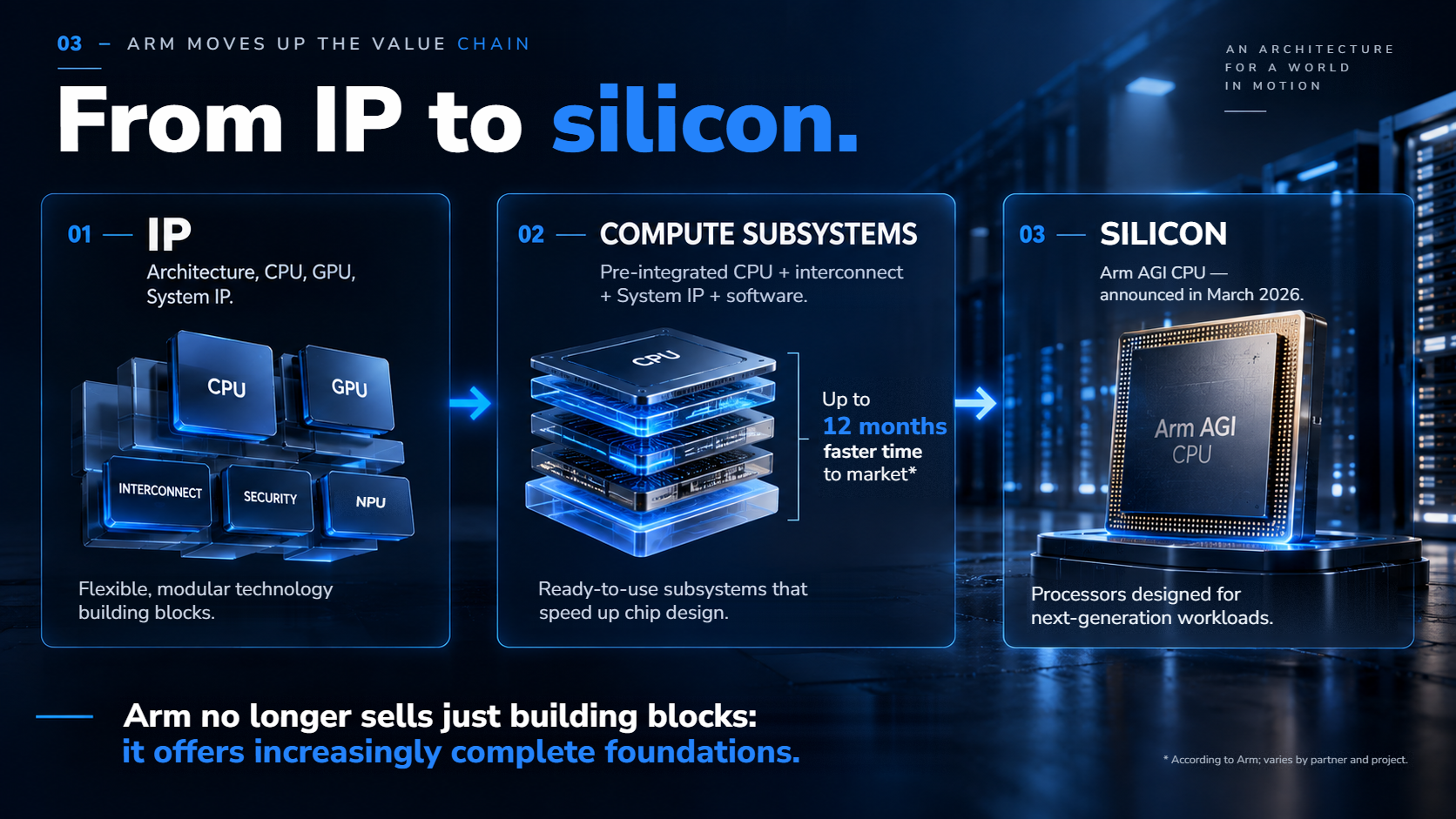
Arm now offers Compute Subsystems, or CSS.
They bring together several components that are already integrated and validated: CPUs, interconnects, system intellectual property, software and other elements needed to build a system-on-chip.
The goal is to reduce the integration work left to the customer.
Arm says its partners can save up to 12 months in time to market, depending on the project.
This subtly changes the company’s position.
The more complete the foundation Arm delivers, the larger the share of system design it captures.
In 2026, Arm crosses a historic line
Then came a much sharper break.
In March 2026, Arm announced the Arm AGI CPU, designed for artificial intelligence infrastructure.
For the first time in its more than 35-year history, the company extended its offering directly to a production silicon product designed by Arm. Meta was announced as lead partner and co-developer.
At launch, Arm said early systems were already available, with broader availability expected in the second half of 2026. In July 2026, it said customer demand for the chip had exceeded $2 billion across fiscal years 2027 and 2028 — a measure of demand, not revenue already recorded.
This move does not mean Arm is abandoning licensing.
Rather, it creates several tiers:
IP → Compute Subsystems → complete Arm processors.
One customer can continue to design a highly customized chip from Arm intellectual property.
Another can start with a much more integrated subsystem.
And some infrastructure customers can now use a processor designed by Arm directly.
The company is thus trying to preserve the exceptional reach of its platform model while capturing more value in certain markets.
It is potentially powerful.
But also riskier.
The higher Arm climbs the stack, the closer it gets to its own customers
The historical model had a remarkable quality: Arm could supply the core technology to many companies without necessarily selling the end product against them.
With increasingly complete systems — and now its own processors — that line is becoming blurrier.
Arm acknowledges this itself in its regulatory filings: its new integrated products may be perceived as competing with products sold by some of its customers. Those customers could then reduce their use of Arm technology or turn to alternative architectures.
Two alternatives matter in particular:
- x86, still firmly established in computing and servers
- RISC-V, an open architecture likely to appeal to companies looking to reduce their dependence on proprietary intellectual property
This tension has already reached the courtroom. On October 13, 2026, in a case brought by Qualcomm, a federal jury in Delaware found that Arm had breached its architecture license agreement with Qualcomm and had intentionally interfered with Qualcomm’s business relationship with Meta, the lead partner for Arm’s AGI CPU. The same jury ruled for Arm on four of the six claims before it and awarded Qualcomm nominal damages of $2. Two questions were not settled by the verdict and remain for the judge to decide: whether the breach entitles Qualcomm to suspend its royalty payments for five years, and whether Arm met its obligation to negotiate future architecture license terms in good faith. Either party could appeal.
Arm therefore has to solve a delicate equation:
capturing more value without destroying the neutrality that helped make it successful.
A dominance that hides several vulnerabilities
Arm’s scale is spectacular, but it does not eliminate risk.
Its five largest customers accounted for about 57% of its FY2026 revenue.
The Chinese market accounted for about 18% of revenue, while Arm China, its largest individual customer, accounted for about 16%.
And, as we have seen, mobile applications processors still generated about 43% of royalties.
Arm therefore remains exposed to several concentrations: customers, geography and end market.
Added to this are trade tensions, technology restrictions, competition from RISC-V and x86, legal disputes with major licensees, and a new risk: executing a far more ambitious strategy in complete systems and silicon.
Arm’s real product is not a chip
That is what makes Arm unusual.
For decades, its advantage did not lie in making more processors than anyone else.
It lay in making other companies want to build their processors on its technology.
That is why its architecture can be found simultaneously in a smartphone, a car, a connected device, a computer and a server.
But the story is now entering a new phase.
Arm is no longer content to supply the building blocks.
It increasingly assembles them.
And, in some cases, it now delivers the silicon itself.
The strategic question is therefore no longer just how many devices will use Arm.
It is how far Arm can move up the value chain without weakening the ecosystem that made its immense reach possible.
Key takeaways
- More than 350 billion Arm-based chips have been shipped, and more than 99% of smartphones use processors based on its architecture.
- The licensing-plus-royalty model lets Arm share economically in billions of chips without manufacturing them itself.
- Compute Subsystems, and then the AGI CPU, show Arm gradually moving up from IP toward far more integrated solutions.
- This shift can increase the value Arm captures, but it also raises the risk of competing with its partners and its exposure to x86 and RISC-V.
Sources
Technical and historical information comes from Arm’s official documentation and a computing-history archive; financial data comes from Arm’s filings with the U.S. Securities and Exchange Commission and its results releases; the October 2026 verdict is reported from press coverage of the trial.
- Arm Holdings plc — Annual Report on Form 20-F, fiscal year 2026. sec.gov — Business model, 350 billion chips, 22 million developers, customer concentration, exposure to China, weight of mobile, risks and x86 / RISC-V competition.
- Arm — Investor Relations. investors.arm.com — More than 350 billion chips, Arm’s footprint and 99% of smartphones.
- Arm — The official history of Arm. newsroom.arm.com — ARM1 designers, Acorn, Apple, VLSI and the creation of Advanced RISC Machines.
- Centre for Computing History — First ARM processor powered up (April 26, 1985). computinghistory.org.uk — First ARM1 silicon in 1985.
- Arm — Licensing Arm Technology and Subscriptions. arm.com — How Arm licensing works.
- Arm — Arm Compute Subsystems (CSS). arm.com — CSS, integration and up to 12 months faster time to market, according to Arm.
- Arm — Arm expands compute platform to silicon products in historic company first (March 24, 2026). newsroom.arm.com — Arm AGI CPU, Meta as lead partner and co-developer, availability.
- Arm — Fourth-quarter and fiscal year 2026 shareholder letter (Exhibit 99.2, May 6, 2026). sec.gov — FY2026 revenue of $4.92 billion, including $2.61 billion in royalties and $2.31 billion in licensing and other revenue; data center royalties.
- Arm — Arm delivers record first-quarter for total revenue (July 29, 2026). newsroom.arm.com — Q1 FY2027 revenue of $1.29 billion, data center royalties and AGI CPU customer demand above $2 billion across FY2027–FY2028.
- CNBC — Delaware jury awards Qualcomm $2 in damages, finds Arm breached license agreement (October 13, 2026). cnbc.com — Verdict on the architecture license agreement and the Meta relationship.
- Tom’s Hardware — Qualcomm wins architecture breach verdict against Arm but gets just $2 — judge could still suspend royalty fees for five years (October 2026). tomshardware.com — Claims decided, statements from both companies and questions still pending before the judge.