For decades, NVIDIA was best known to the public for its graphics cards.
Today, its technologies sit at the heart of the infrastructure used to train and run some of the world’s most demanding artificial intelligence systems.
That transformation might suggest that NVIDIA simply built the right chip at the right time.
The reality runs much deeper.
NVIDIA did not just develop more powerful GPUs. It gradually built the layers needed to turn those GPUs into infrastructure: programming tools, software libraries, interconnects, networking, complete systems, and deployment technologies.
Understanding that integration explains how a company once associated primarily with graphics became one of the world’s leading providers of AI infrastructure.
1. The Bet That Came Before the AI Boom
The story begins long before ChatGPT and large language models.
GPUs were originally designed to perform large numbers of calculations simultaneously for graphics rendering. Over time, that ability to process operations in parallel proved valuable far beyond video games.
But there was a fundamental obstacle.
Having massively parallel processors was not enough. Developers also needed a practical way to program them without relying on tools originally designed for graphics.
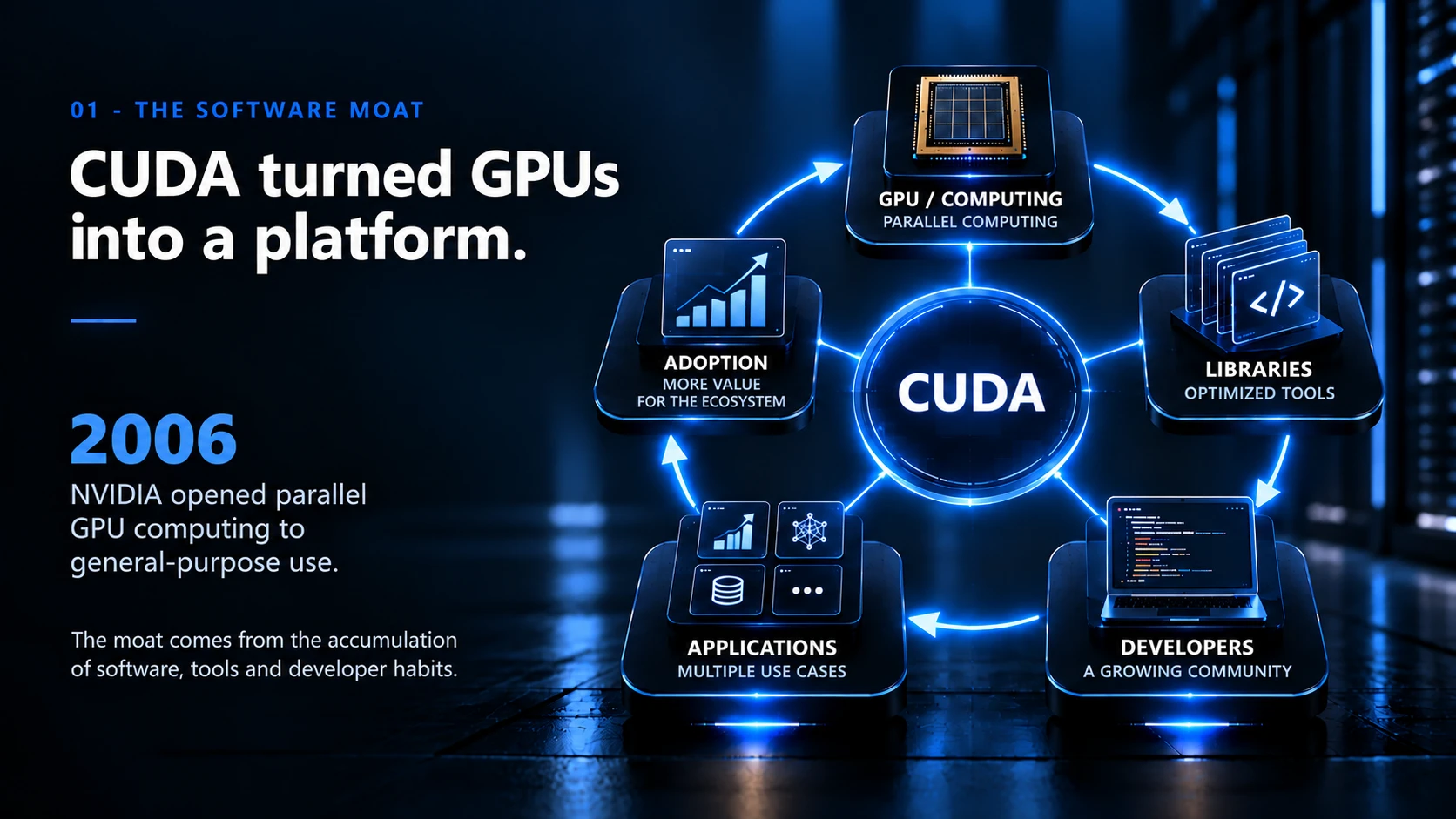
In 2006, NVIDIA introduced CUDA, a parallel computing platform and programming model that enabled GPUs to perform general-purpose computing tasks.
That decision changed the company’s trajectory.
NVIDIA was no longer selling only a chip.
It was also providing the software foundation researchers and developers needed to build applications around that chip.
Over the following years came compilers, optimized libraries, development tools, and specialized frameworks. NVIDIA has reported an ecosystem of more than six million CUDA developers and approximately 40,000 companies using its platforms. These are company-reported figures, rather than independently audited measures of adoption.
This is where NVIDIA’s structural advantage began: each new generation of hardware could enter an existing software environment.
A competitor can design an exceptionally powerful accelerator.
Reproducing the hardware, libraries, tools, optimizations, and developer expertise accumulated around an established platform is a different challenge altogether.
The cost of switching is therefore not limited to the price of a chip. It also includes the time required to adapt, test, optimize, and maintain the software running on it.
2. Then Artificial Intelligence Changed the Scale
NVIDIA’s early software advantage could have remained confined to scientific computing and specialized applications.
Deep learning changed that trajectory.
Modern neural networks rely heavily on mathematical operations that can be processed in parallel. GPUs therefore became particularly well suited to training these models.
But as AI models grew larger, another problem emerged.
A single GPU was no longer enough.
Dozens, then hundreds, and eventually thousands of accelerators had to work together.
At that scale, system performance no longer depends solely on how fast each processor operates.
It also depends on how efficiently processors exchange data.
Networking becomes part of the computation itself.
3. The Strategic Significance of Mellanox
That is what makes NVIDIA’s acquisition of Mellanox so important.
In 2019, NVIDIA announced plans to acquire the high-performance networking specialist in a transaction valued at approximately $6.9 billion in enterprise value. The acquisition closed in April 2020.
At first glance, acquiring a networking company might have seemed far removed from NVIDIA’s traditional GPU business.
At the scale of modern AI, the opposite was true.
When a model is distributed across large numbers of accelerators, those GPUs must communicate continuously.
Even an extremely powerful processor can sit underutilized if data cannot reach it quickly enough.
Mellanox brought NVIDIA critical expertise in high-performance interconnects, including InfiniBand.
NVIDIA also developed NVLink and subsequently expanded its Ethernet capabilities through Spectrum-X.
The company’s ambition was no longer simply to accelerate individual GPUs.
It was to accelerate the entire system.
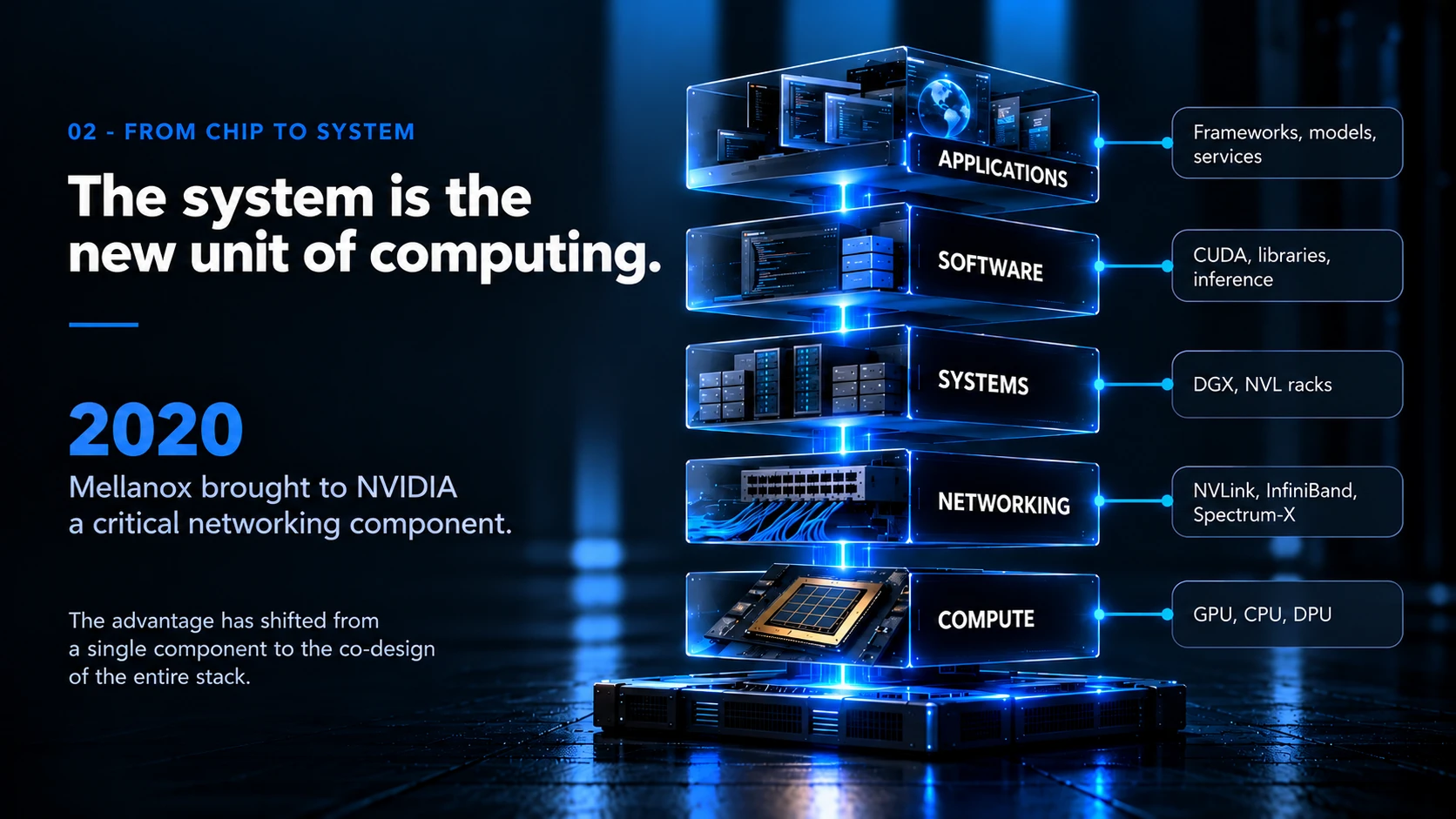
This evolution gradually changed the definition of NVIDIA’s product.
That product can still be a chip.
But it can also be a module, a server, an entire rack, or a data center architecture combining GPUs, CPUs, DPUs, memory, switches, interconnects, and software.
4. The Data Center Becomes the Unit of Computing
With Blackwell and then Vera Rubin, this strategy became increasingly explicit.
NVIDIA now designs its platforms around the rack and the data center, rather than treating each GPU as an isolated product.
The Vera Rubin NVL72 platform, for example, combines 72 Rubin GPUs, 36 Vera CPUs, ConnectX-9 SuperNICs, BlueField-4 DPUs, and NVLink 6. InfiniBand or Spectrum-X Ethernet can then extend connectivity beyond the rack.
In this generation, NVLink 6 provides up to 3.6 TB/s of bidirectional bandwidth per GPU.
That technical specification illustrates a much larger strategic shift.
NVIDIA now optimizes multiple layers together:
Compute → Memory → Communication → Networking → Software → Deployment
The company itself describes its Data Center business as an integrated platform combining computing and networking infrastructure, often delivered through rack-scale systems, subsystems, or modules, alongside software and services.
That is why NVIDIA increasingly resembles an infrastructure provider rather than simply a semiconductor manufacturer.
5. Why Customers Buy an Entire Platform
For an AI laboratory or cloud provider, the ultimate objective is not necessarily to own the theoretically fastest GPU.
It is to obtain the greatest amount of useful computing capacity within a given budget, power envelope, and timeframe.
Achieving that requires every layer to work together.
NVIDIA can optimize its architecture across GPUs, memory, NVLink, networking, software libraries, and inference engines.
This integration reduces some of the engineering work customers would otherwise need to perform when assembling and optimizing infrastructure built from multiple suppliers.
It also creates a powerful economic mechanism.
The more widely NVIDIA infrastructure is deployed, the more developers optimize their applications for its environment.
The richer that software environment becomes, the more attractive the platform grows.
And as deployment volumes increase, NVIDIA gains additional resources to invest in the next generation.
This cycle does not make competition impossible.
But it raises the number of layers across which a rival must compete effectively at the same time.
6. The Numbers Reveal a Company That Has Moved Beyond Graphics Cards
The financial transformation is extraordinary.
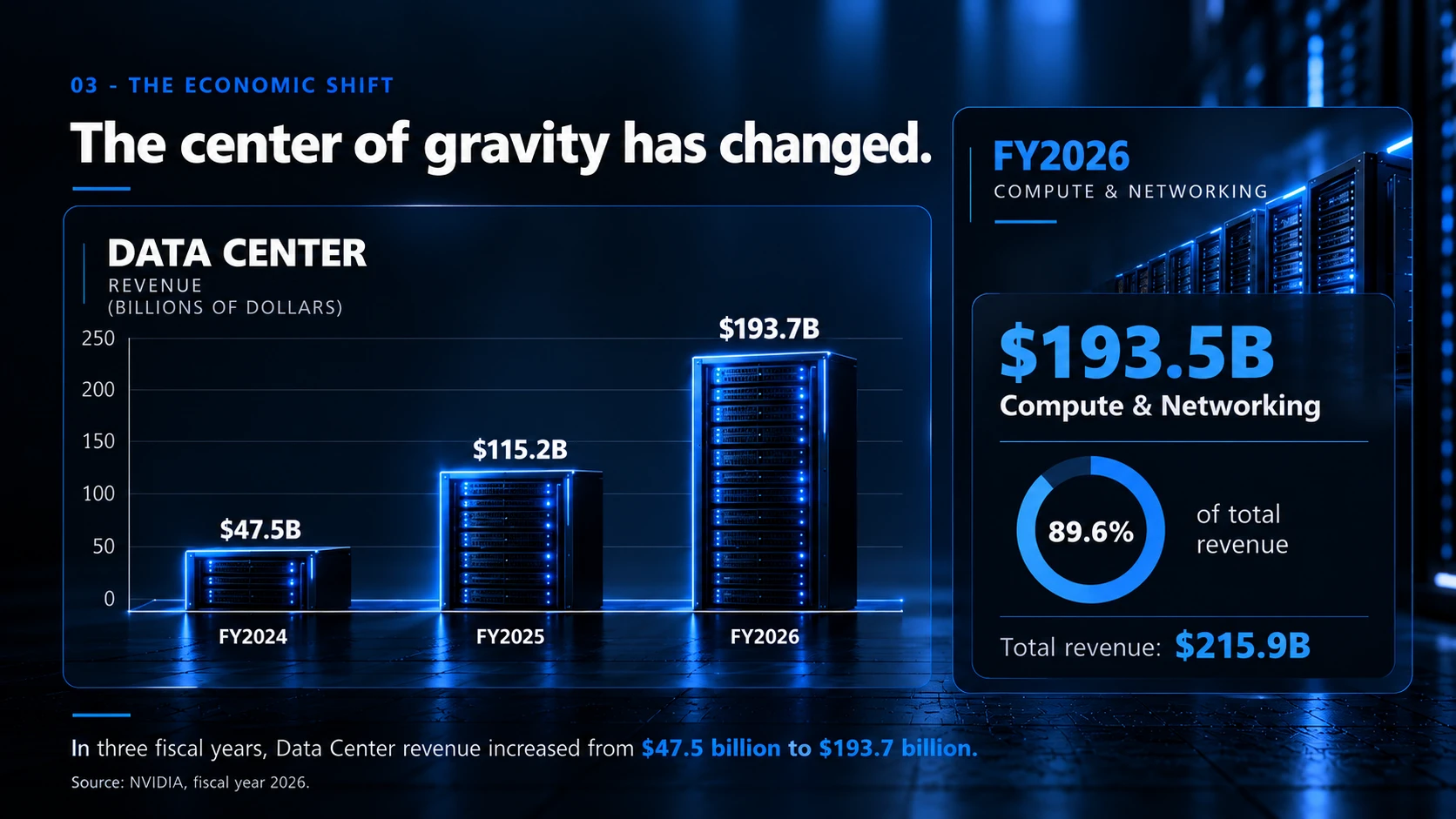
In fiscal 2026, NVIDIA reported total revenue of $215.9 billion.
Its Compute & Networking reporting segment generated $193.5 billion, representing approximately 89.6% of total revenue. Segment revenue increased 67% year over year.
Even more revealing, revenue attributed to the Data Center end market reached $193.7 billion, compared with $115.2 billion one year earlier and $47.5 billion two years earlier.
These figures measure different reporting categories: Compute & Networking is an operating segment, while Data Center is an end-market classification. They should not be interpreted as identical accounting boundaries.
And the momentum no longer comes exclusively from accelerators.
In fiscal 2026, NVIDIA’s Data Center networking revenue increased 142%, supported by the expansion of NVLink computing fabrics, Ethernet, and InfiniBand.
Networking growth has therefore become evidence of NVIDIA’s broader strategic shift.
The company is no longer selling only the engines of the system.
It is increasingly selling the connections that allow those engines to operate together.
7. NVIDIA Is Now Trying to Set the Pace of Infrastructure Upgrades
Even a dominant infrastructure platform can become vulnerable if it evolves too slowly.
NVIDIA has therefore accelerated its product roadmap.
Following Hopper and Blackwell, the company began shipping its next-generation Vera Rubin architecture.
In its regulatory filing for the quarter ended July 26, 2026, NVIDIA reported that Vera Rubin production shipments began in the third quarter of fiscal 2027. The company subsequently confirmed that shipments had commenced in August 2026.
The strategic objective extends beyond launching another generation of GPUs.
NVIDIA wants customers to think in terms of complete platform generations.
Each new architecture can simultaneously change the GPU, CPU, memory, interconnects, and networking technologies.
Software compatibility can then help preserve part of the investment customers have already made in previous generations.
This combination is difficult to replicate: advancing hardware rapidly while allowing the surrounding software ecosystem to evolve without starting over.
8. But Infrastructure Does Not Mean Invulnerability
NVIDIA’s scale also creates significant risks.
The first is competition.
AMD, specialized AI accelerators, and chips developed by major cloud providers can challenge different layers of NVIDIA’s platform.
NVIDIA itself acknowledges intense competition, identifying performance, software capabilities, manufacturing capacity, pricing, and total system cost as important competitive factors.
The second risk is industrial dependence.
NVIDIA designs its chips but relies on an extensive external manufacturing ecosystem.
Its supply chain includes companies such as TSMC and Samsung for semiconductor manufacturing, SK hynix, Micron, and Samsung for memory, and advanced packaging technologies such as CoWoS.
The scale of that dependence is striking.
As of July 26, 2026, NVIDIA reported $279 billion in supply and capacity commitments, primarily associated with meeting future demand for its Data Center infrastructure systems.
The third risk is customer concentration.
In fiscal 2026, two direct customers accounted for 22% and 14%, respectively, of NVIDIA’s total revenue.
The fourth risk is geopolitical.
US export restrictions affecting certain products destined for China have already imposed measurable costs.
In 2025, NVIDIA recorded a $4.5 billion charge related to H20 inventory and purchase obligations following new export licensing requirements.
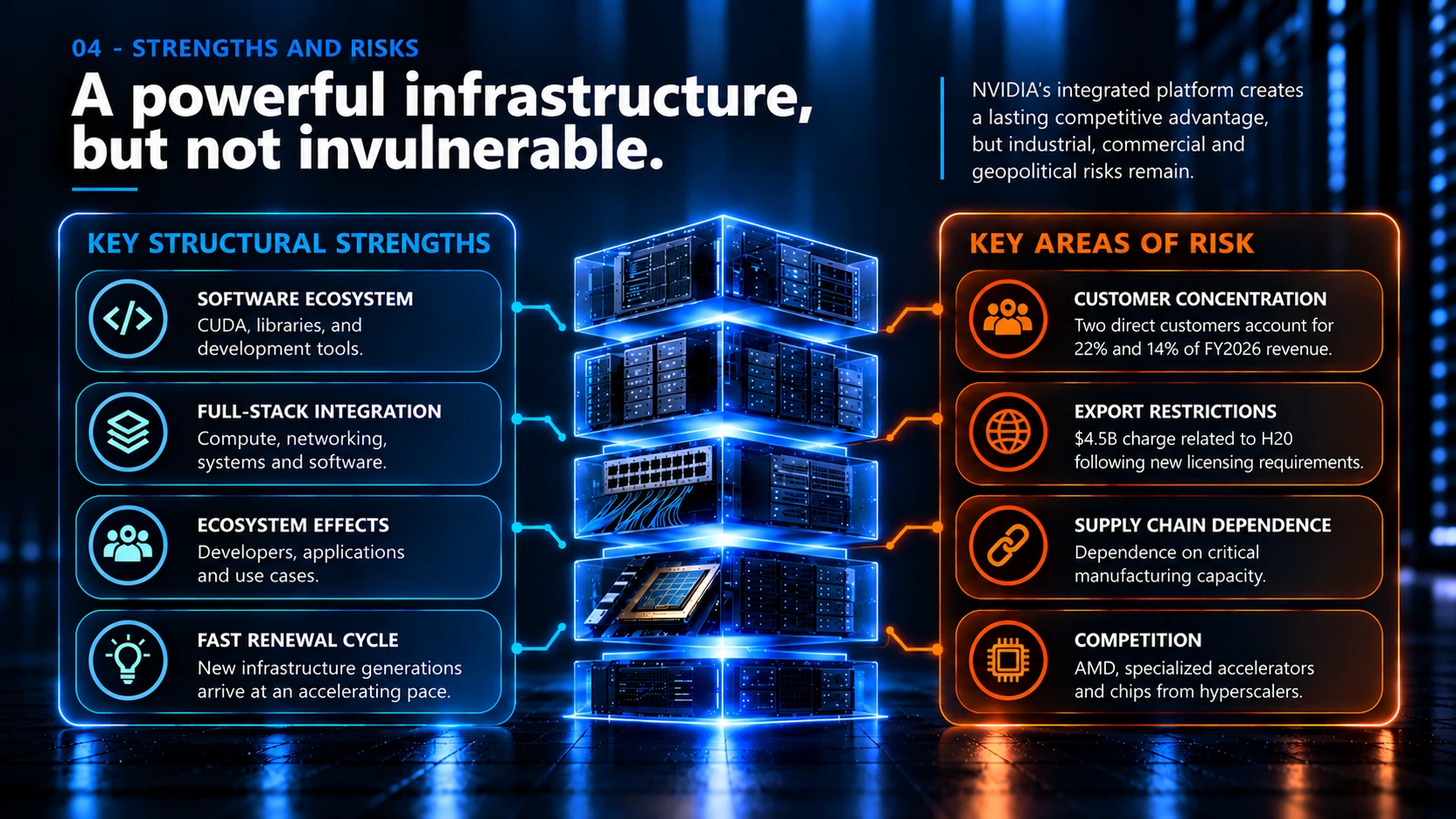
These constraints reveal NVIDIA’s central paradox.
The more essential the company becomes to AI infrastructure, the more it depends on an extraordinarily complex industrial supply chain, a relatively small number of major buyers, and geopolitical decisions beyond its control.
9. What NVIDIA Is Really Selling
Reducing NVIDIA to its GPUs means focusing on only the most visible layer.
The GPU remains essential.
But the strategic value increasingly comes from everything surrounding it.
CUDA makes the GPU programmable.
Software libraries help developers exploit its capabilities.
NVLink connects accelerators.
InfiniBand and Spectrum-X extend communication across the data center.
DGX and NVL systems bring the components together.
And the software stack turns that infrastructure into usable computing capacity.
Key takeaways
- NVIDIA became a central provider of AI infrastructure by transforming its GPU advantage into an integrated platform spanning computing, software, interconnects, networking, and complete systems.
- Its competitive advantage does not come from a single chip.
- It comes from the difficulty of replacing the entire technology stack at once.
- Its greatest challenge is to keep advancing that infrastructure faster than competitors can successfully challenge or replace its individual layers.
Sources
Technical specifications are drawn from NVIDIA’s official documentation. Financial figures and risk disclosures are drawn from NVIDIA’s annual reports and regulatory filings with the US Securities and Exchange Commission.
- NVIDIA — CUDA Programming Guide, Introduction. docs.nvidia.com — CUDA’s programming model and its introduction in 2006.
- NVIDIA — Annual CEO Letter 2025. images.nvidia.com — Company-reported CUDA developer and ecosystem metrics.
- NVIDIA — Announcement of Mellanox Acquisition, 2019. nvidianews.nvidia.com — Acquisition announcement and transaction value.
- NVIDIA — Rubin Data Center Technology. nvidia.com — Vera Rubin platform architecture and specifications.
- NVIDIA Developer Blog — NVLink: The Scale-Up Network for AI Factories. developer.nvidia.com — NVLink 6 bandwidth specifications.
- NVIDIA — FY2026 Annual Report. s201.q4cdn.com — Platform strategy, fiscal performance, and business reporting.
- NVIDIA — Fiscal 2027 First-Quarter Regulatory Filing. sec.gov — Fiscal 2026 business overview and networking revenue growth.
- NVIDIA — FY2026 Form 10-K. sec.gov — Revenue by end market, reportable segments, financial results, and customer concentration.
- NVIDIA — Form 10-Q, Quarter Ended July 26, 2026. sec.gov — Vera Rubin production shipments and supply and capacity commitments.
- NVIDIA — FY2026 Form 10-K, Business and Risk Factors. sec.gov — Competition, manufacturing dependencies, and H20-related charges.
- NVIDIA — FY2027 Second-Quarter Earnings Call, August 26, 2026. investor.nvidia.com — Confirmation of the Vera Rubin production shipment timeline.